The third chapter of Family Records, 1962: “Items of family interest told to me by my grandfather, Michael Lawson Holt,” which Ruby wrote down about twenty years before his death in 1956. He tells of his father Jordan Holt’s mill in Tarrant County, of the move to Wise County, Texas, of buying his father’s land at a sheriff’s sale as a teenager, of courting Mary Theodocia Greer, and of the ranch in Taylor County where he bought 1,000 acres. Ruby adds that a “Holt Avenue” in Planada, California, runs through the land Grandpa Holt first bought there.
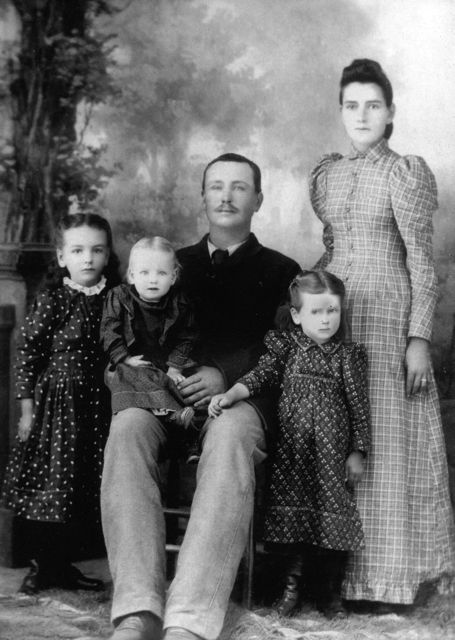
See Michael and Mary Holt for more about the couple, and Origin of Michael Holt for a later account that differs in places.
In brief
- His Holt grandparents were Isaac Lawson Holt and Fannie Pryor, a “domineering” Irishwoman who ran the farm and her sons with a cowhide whip.
- His mother, Ann Shofner, studied at the Female Lutheran College in Winchester, Tennessee, and taught school until the Civil War.
- His father was for the North, so Rebels burned the family’s home and mills. The Holts started over in Texas when Michael was about five.
- Jordan ran the first mill in Tarrant County. Mills there were sometimes turned by teams of wild longhorns, and Michael saw the first train come into Dallas.
- Jordan died “mysteriously in convulsions”; Michael suspected his third wife. Michael bought the family land at a sheriff’s sale and raised the younger children.
- He threw Mary Greer’s bonnet up on the barn to make her stay longer. They married about six months later: “maw was the most beautiful girl I had ever seen.”
How to read this transcription: each typed page is shown beside its scan (tap a scan to see it full size). Highlighted words were written in by hand on the typed page; [square brackets] are our notes; spelling is kept as typed.
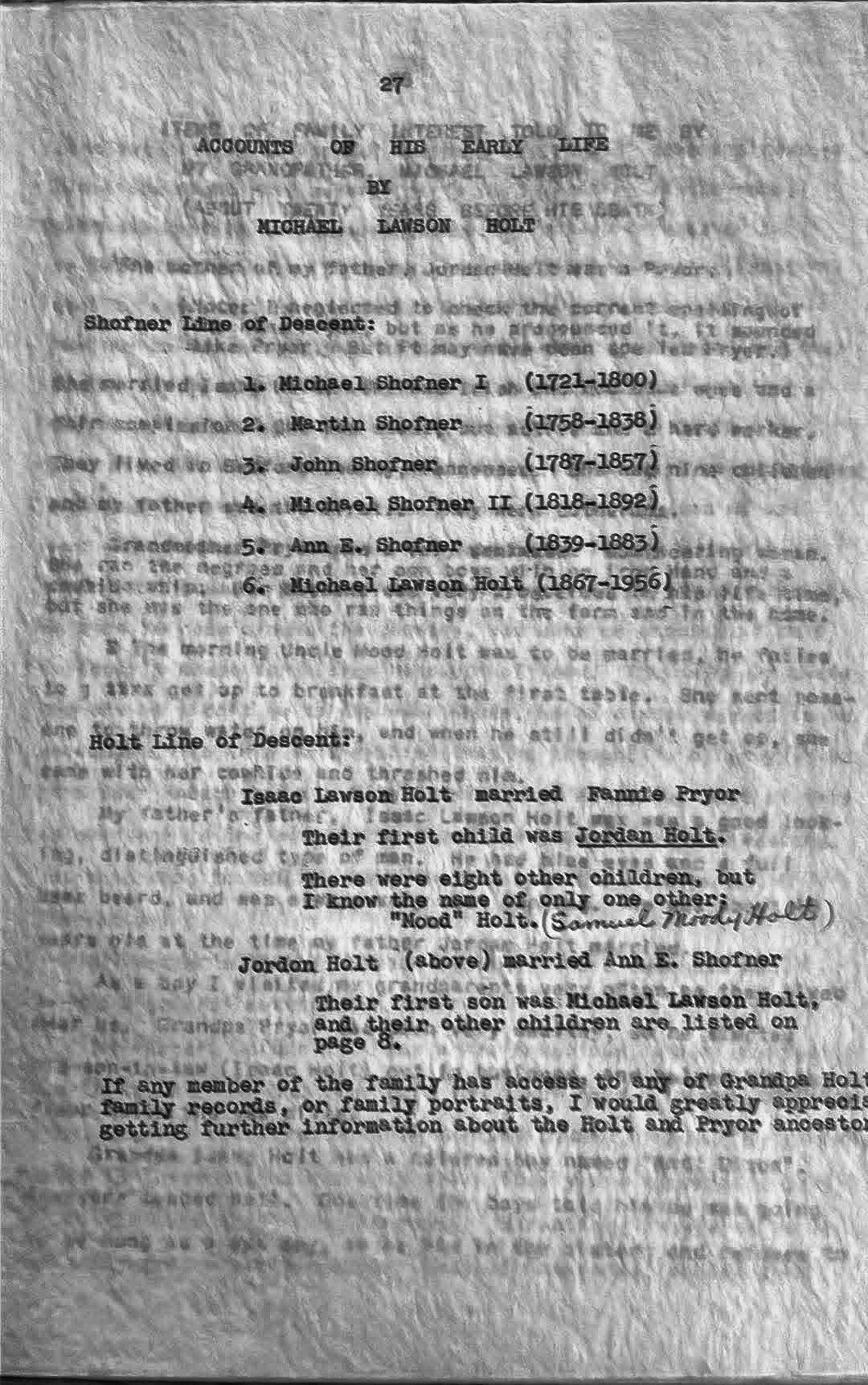
ACCOUNTS OF HIS EARLY LIFE, BY MICHAEL LAWSON HOLT
Shofner Line of Descent:
1. Michael Shofner I (1721–1800)
2. Martin Shofner (1758–1838)
3. John Shofner (1787–1857)
4. Michael Shofner II (1818–1892)
5. Ann E. Shofner (1839–1883)
6. Michael Lawson Holt (1867–1956)
Holt Line of Descent:
Isaac Lawson Holt married Fannie Pryor. Their first child was Jordan Holt. There were eight other children, but I know the name of only one other: “Mood” Holt. Samuel Moody Holt
Jordon Holt (above) married Ann E. Shofner. Their first son was Michael Lawson Holt, and their other children are listed on page 8.
If any member of the family has access to any of Grandpa Holt[‘s] family records, or family portraits, I would greatly apprecia[te] getting further information about the Holt and Pryor ancesto[rs].
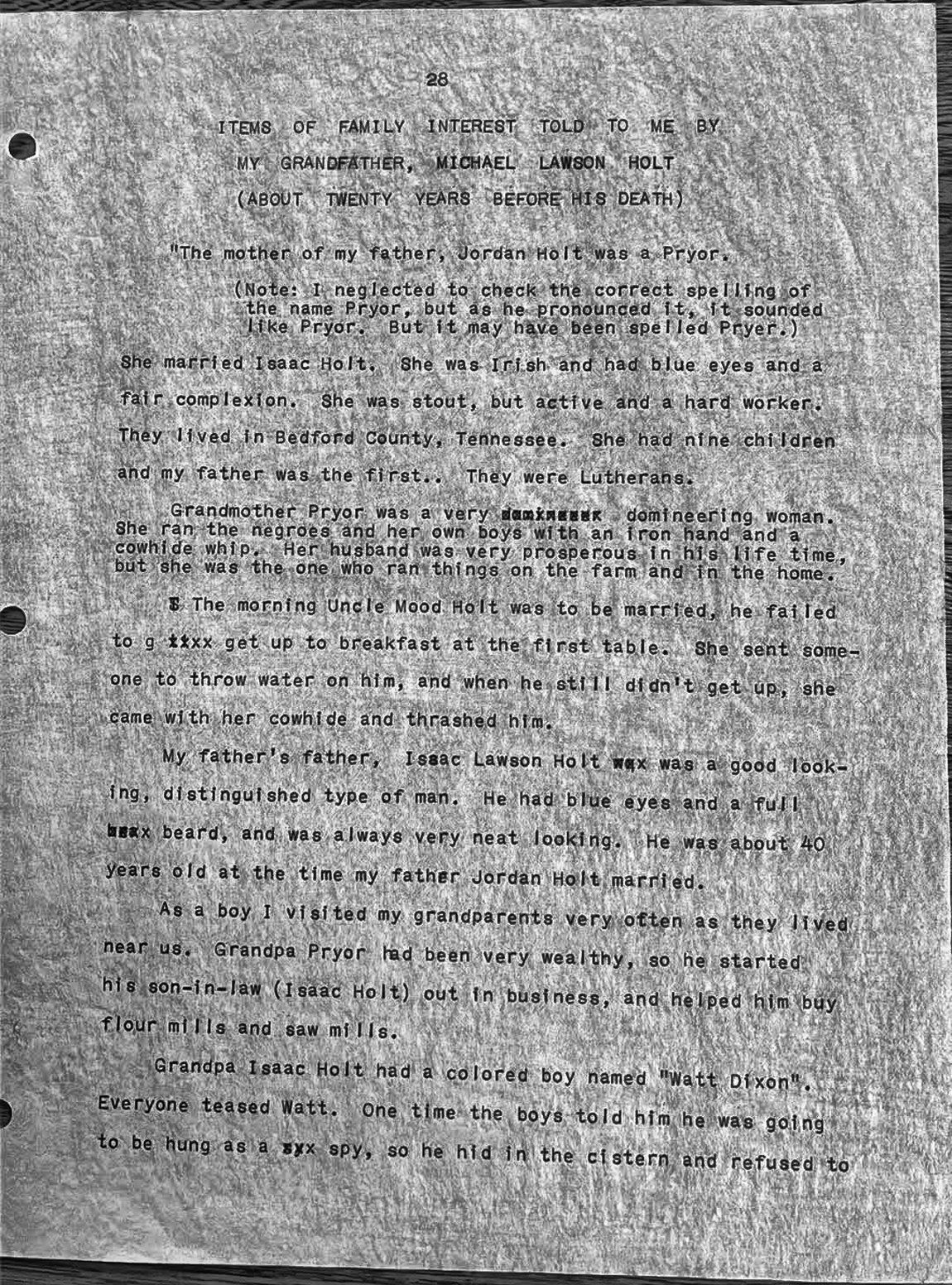
ITEMS OF FAMILY INTEREST TOLD TO ME BY MY GRANDFATHER, MICHAEL LAWSON HOLT (ABOUT TWENTY YEARS BEFORE HIS DEATH)
“The mother of my father, Jordan Holt was a Pryor.
(Note: I neglected to check the correct spelling of the name Pryor, but as he pronounced it, it sounded like Pryor. But it may have been spelled Pryer.)
She married Isaac Holt. She was Irish and had blue eyes and a fair complexion. She was stout, but active and a hard worker. They lived in Bedford County, Tennessee. She had nine children and my father was the first. They were Lutherans.
Grandmother Pryor was a very domineering woman. She ran the negroes and her own boys with an iron hand and a cowhide whip. Her husband was very prosperous in his life time, but she was the one who ran things on the farm and in the home.
The morning Uncle Mood Holt was to be married, he failed to get up to breakfast at the first table. She sent someone to throw water on him, and when he still didn’t get up, she came with her cowhide and thrashed him.
My father’s father, Isaac Lawson Holt was a good looking, distinguished type of man. He had blue eyes and a full beard, and was always very neat looking. He was about 40 years old at the time my father Jordan Holt married.
As a boy I visited my grandparents very often as they lived near us. Grandpa Pryor had been very wealthy, so he started his son-in-law (Isaac Holt) out in business, and helped him buy flour mills and saw mills.
Grandpa Isaac Holt had a colored boy named “Watt Dixon”. Everyone teased Watt. One time the boys told him he was going to be hung as a spy, so he hid in the cistern and refused to
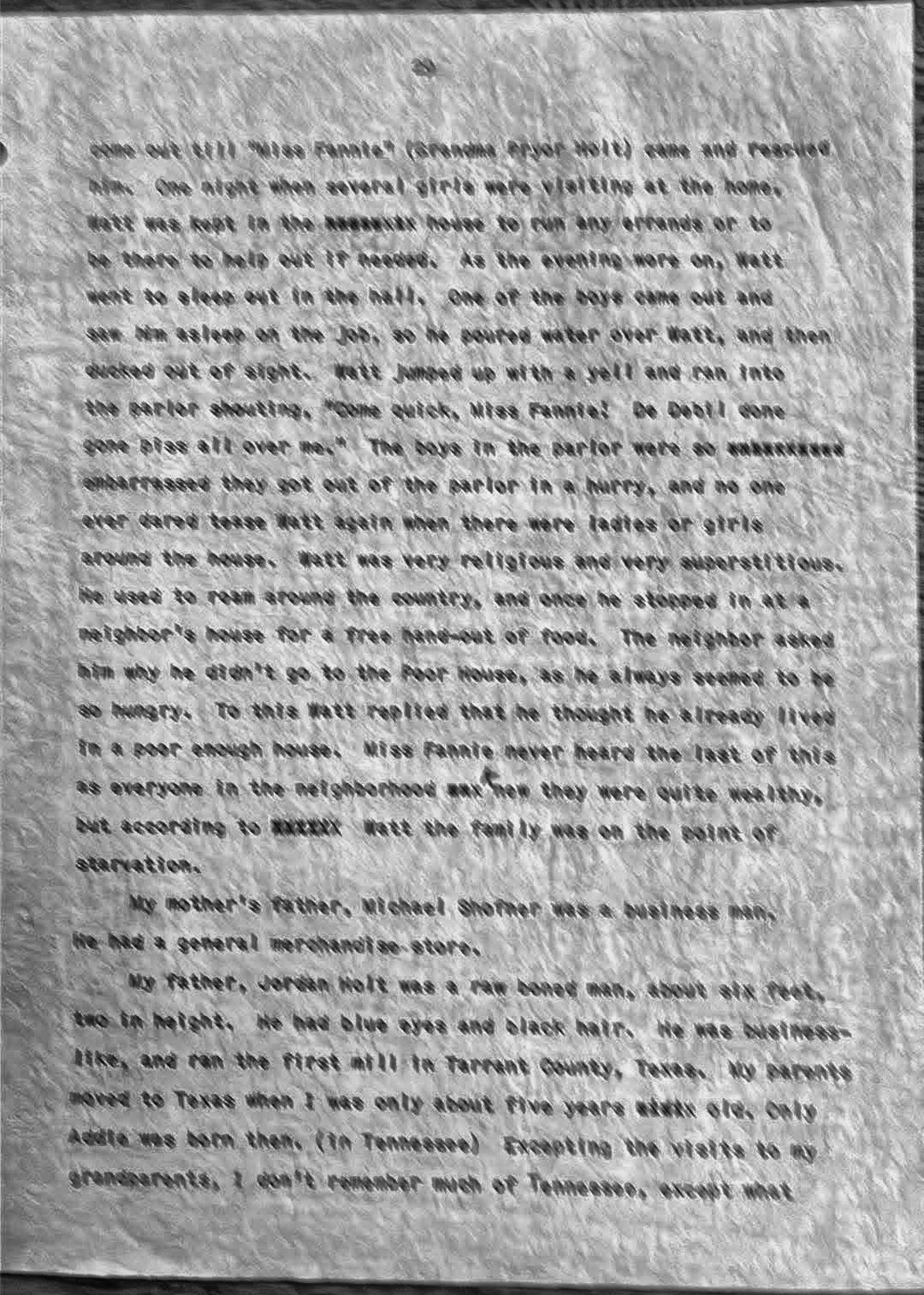
come out till “Miss Fannie” (Grandma Pryor Holt) came and rescued him. One night when several girls were visiting at the home, Watt was kept in the house to run any errands or to be there to help out if needed. As the evening wore on, Watt went to sleep out in the hall. One of the boys came out and saw him asleep on the job, so he poured water over Watt, and then ducked out of sight. Watt jumped up with a yell and ran into the parlor shouting, “Come quick, Miss Fannie! De Debil done gone piss all over me.” The boys in the parlor were so embarrassed they got out of the parlor in a hurry, and no one ever dared tease Watt again when there were ladies or girls around the house. Watt was very religious and very superstitious. He used to roam around the country, and once he stopped in at a neighbor’s house for a free hand-out of food. The neighbor asked him why he didn’t go to the Poor House, as he always seemed to be so hungry. To this Watt replied that he thought he already lived in a poor enough house. Miss Fannie never heard the last of this as everyone in the neighborhood knew they were quite wealthy, but according to Watt the family was on the point of starvation.
My mother’s father, Michael Shofner was a business man. He had a general merchandise store.
My father, Jordan Holt was a raw boned man, about six feet, two in height. He had blue eyes and black hair. He was business-like, and ran the first mill in Tarrant County, Texas. My parents moved to Texas when I was only about five years old. Only Addie was born then. (In Tennessee) Excepting the visits to my grandparents, I don’t remember much of Tennessee, except what
I heard from my parents. In Texas my father had a small farm and used free negroes. He was a Mason and an Odd Fellow. He has a Masonic tombstone.
While my parents were still in Tennessee, the Civil War came. Our family was divided. Some were for the North and some for the South. My father was for the North, so the southerners who were Rebels burned his home and mills, and he lost everything he had. That is why we came West to Texas. He had been commissioned by the state of Tennessee as a first lieutenant in the National Guard.
“My father died mysteriously in convulsions when he was about 50 years of age. I think his third wife poisoned him. At any rate she took all of his possessions and moved back to Indian Territory. At the time of my father’s death, only three of the children were married, so I cared for the younger ones.”
My mother, Ann E. Shofner Holt was a small woman, with small hands and feet. She wore a size 3 shoe. She was stout, with blue eyes and straight black hair. She had a gentle disposition and was a hard worker. For the times then, she was a highly educated woman as she had gone to the Female Lutheran College in Winchester, Tennessee. She studied to be a school teacher there, and later taught school until the Civil War started.
She died with brain fever – just went to sleep and never woke up. I was about 15 at the time.
When we first moved to Texas, after losing everything in Tenn., we had only a small farm. We raised corn and a little cotton and had about 15 to 20 cows. There was a big log house on the place we bought. My mother had only “Aunt” Judy, a free negress to help her. All cooking was done on a big fireplace as we had
no iron stoves at that time. After my mother died, we moved to Wise County, Texas, where my father bought 160 acres of land. There was a house already built on the land. While we always had log houses or plank houses, many of the neighbors had only sod houses or dugouts. Buffalo chips were used for fuel and to heat branding irons. Once there was an Indian raid about fourteen miles from Grapevine. The Indians would raid over chasing buffalo, so the authorities figured the only way to keep them out, was to not let the Indians kill buffalo just for the hides. So a law was passed that required every person who killed a buffalo to take at least ¼ of the animal for meat. That way the Indians and whites alike could no longer kill the buffalo just to get the hides.
When my father would go to Casa, Texas for supplies, (a three hundred mile round trip), he would be gone three months. As I grew up, the town of Grapevine grew too, so that by the time I was 21, there was were between 500 and 600 people living there. When I was about 7 years old, I had seen the first train come into Dallas. At this time women still spun, and knitted sox. My mother did. Leather was always plentiful, and there were many tanning yards. Shoes were all hand made by shoemakers.
The early day mills used in Texas were often powered by wild Texas long horn cattle. Farmers would go out and round up some of the wild cattle running loose and then would hitch them four abreast to turn the big mill wheels to grind grain and corn. Sometimes as many as sixteen would be used at one time. There were big wooden cogs on the side of the wheel, which ran on another big wheel, that ran into steel cogs. When used
for cotton, the mills were fed by hand to regulate the speed. The cotton went in at the top in the gin stand, after the seed were out. Then the cotton was pressed into stall like bars, between each two or three pulls.
The wild cattle cost nothing, and many a cattle man in Texas got his start this way. Of course land was cheap and grass on the prairie was waist deep.
Many a time babies’ lives were saved out on the plains of Texas by the scant cup or so of milk the family could get out of one of the scrawny wild cows. When a new born baby’s mother would die at birth, and there were no neighbors for miles, the baby would have died for sure with out this little bit of milk.
(Note here an interesting fact. While I got these stories from Grandpa Holt about twenty years ago, there was just recently – about 2 or 3 years ago – a story in the Saturday Evening Post, which was fiction. But, it must have been based on true facts, because it, too, told how a father and his young sons rounded up a wild long-horn cow, and with the milk were able to save the life of their baby after the mother died.)
“After my father’s death, I bought his land at a Sheriff’s sale, and built a new home for me and Bettie and Joe. When I was about 16 years old, my first sweetheart was Mary Lindsay. One day Grandma Holt (Mary Theodocia Greer) came to see my new house. She only lived one-fourth of a mile away. I used to go horseback riding with her. She rode side saddle. One day, to get her to stay longer, I threw her bonnet up on the barn. After about six months we were married in Annieville, Texas. Some of her brothers opposed the match, but her father approved. I guess I would have been a heap better off to have married the other girl, but maw was the most beautiful girl I had ever seen, so I married her.”
At the time I was married, I owned 160 acres. I did a little carpenter work, but most all of our income came off the land. We lived on this place for three years. Nettie was born there. Then we sold the place and moved to Taylor County. I bought a small place here where there was public range. The stock could range for sixty miles or more. I built a plank house here. We had three rooms and a porch to start with. We had log barns, at first and better ones later. After a few years I built a front room on to the house. Later, I bought 1,000 acres from $3 to $6 per acre.”
Note: I did not have time to get any of Grandpa’s life after he left Texas. There are enough of the family still living who remember the life in California, so any wishing to do so, can fill in the account from here on.
Grandchildren may be interested in knowing that there is a “Holt Avenue” in the town of Planada, which runs through the property that Grandpa Holt first bought when they moved to California from Texas.
Scans courtesy of Laurel Sharmer. Original typed by Ruby Evangeline Wilson Sharmer, January 1962.

