The second chapter of Family Records, 1962. Ruby summarizes the Shofner Family History chapters on John Shofner (1787–1857), who moved from Orange County, North Carolina, to Bedford County, Tennessee, in 1815; his son Michael Shofner (1818–1892), Ann E. Shofner Holt’s father; and Col. Loton Shofner, whom Ruby included though he was not a direct ancestor.
A note on these pages. Pages 18 to 22 describe the Shofner family’s slaveholding in Tennessee, including a copy of an 1838 bill of sale for a man named Dick. They are reproduced here as Ruby typed them in 1962, in the language of the 1905 book she was summarizing.
In brief
- John Shofner helped survey Bedford County with Newton Cannon, later Governor of Tennessee; the Shofners were among its first settlers.
- He farmed on Duck River near Shelbyville, ran cotton gins and a grain-fan factory, and was a Whig who campaigned for Henry Clay.
- He married his cousin Amelia in 1810; between two wives he had fifteen children, and he gave the land for the Lutheran church at Jenkin’s Chapel.
- The family owned slaves. Ruby copied the 1905 book’s account, including an 1838 bill of sale, and added her own 1961 note questioning its silence about the moral side.
- His son Michael, Ann’s father, kept a store and was a Whig, then a Republican; the brothers seem to have sided with the North. Ann’s husband Jordan Holt served in the Union Army.
- Ann’s uncle, Col. Loton Shofner, wrote the first family history and spent his life fighting liquor.
How to read this transcription: each typed page is shown beside its scan (tap a scan to see it full size). Highlighted words were written in by hand on the typed page; [square brackets] are our notes; spelling is kept as typed.
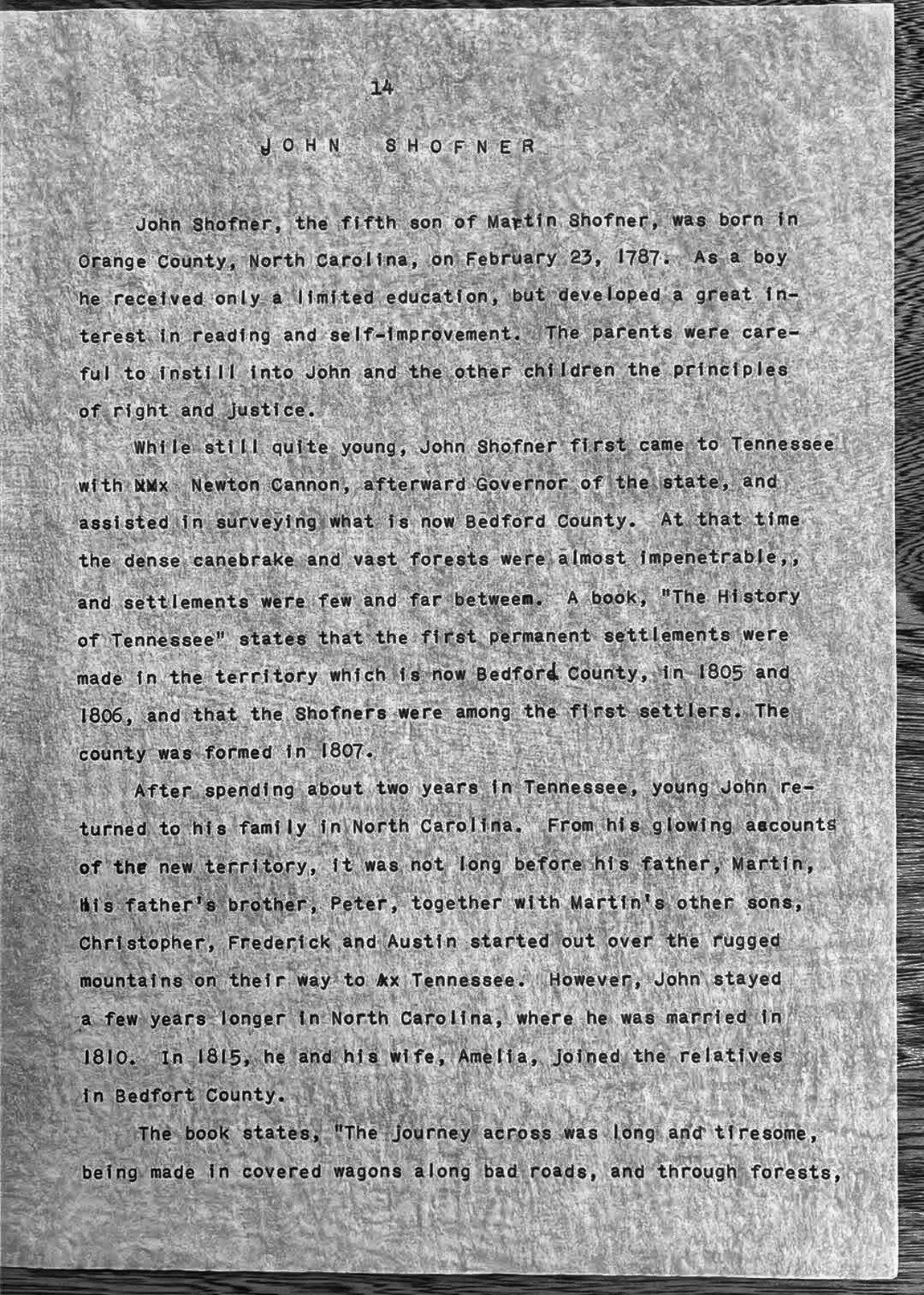
JOHN SHOFNER
John Shofner, the fifth son of Martin Shofner, was born in Orange County, North Carolina, on February 23, 1787. As a boy he received only a limited education, but developed a great interest in reading and self-improvement. The parents were careful to instill into John and the other children the principles of right and justice.
While still quite young, John Shofner first came to Tennessee with Newton Cannon, afterward Governor of the state, and assisted in surveying what is now Bedford County. At that time the dense canebrake and vast forests were almost impenetrable, and settlements were few and far between. A book, “The History of Tennessee” states that the first permanent settlements were made in the territory which is now Bedford County, in 1805 and 1806, and that the Shofners were among the first settlers. The county was formed in 1807.
After spending about two years in Tennessee, young John returned to his family in North Carolina. From his glowing accounts of the new territory, it was not long before his father, Martin, his father’s brother, Peter, together with Martin’s other sons, Christopher, Frederick and Austin started out over the rugged mountains on their way to Tennessee. However, John stayed a few years longer in North Carolina, where he was married in 1810. In 1815, he and his wife, Amelia, joined the relatives in Bedfort County.
The book states, “The journey across was long and tiresome, being made in covered wagons along bad roads, and through forests,
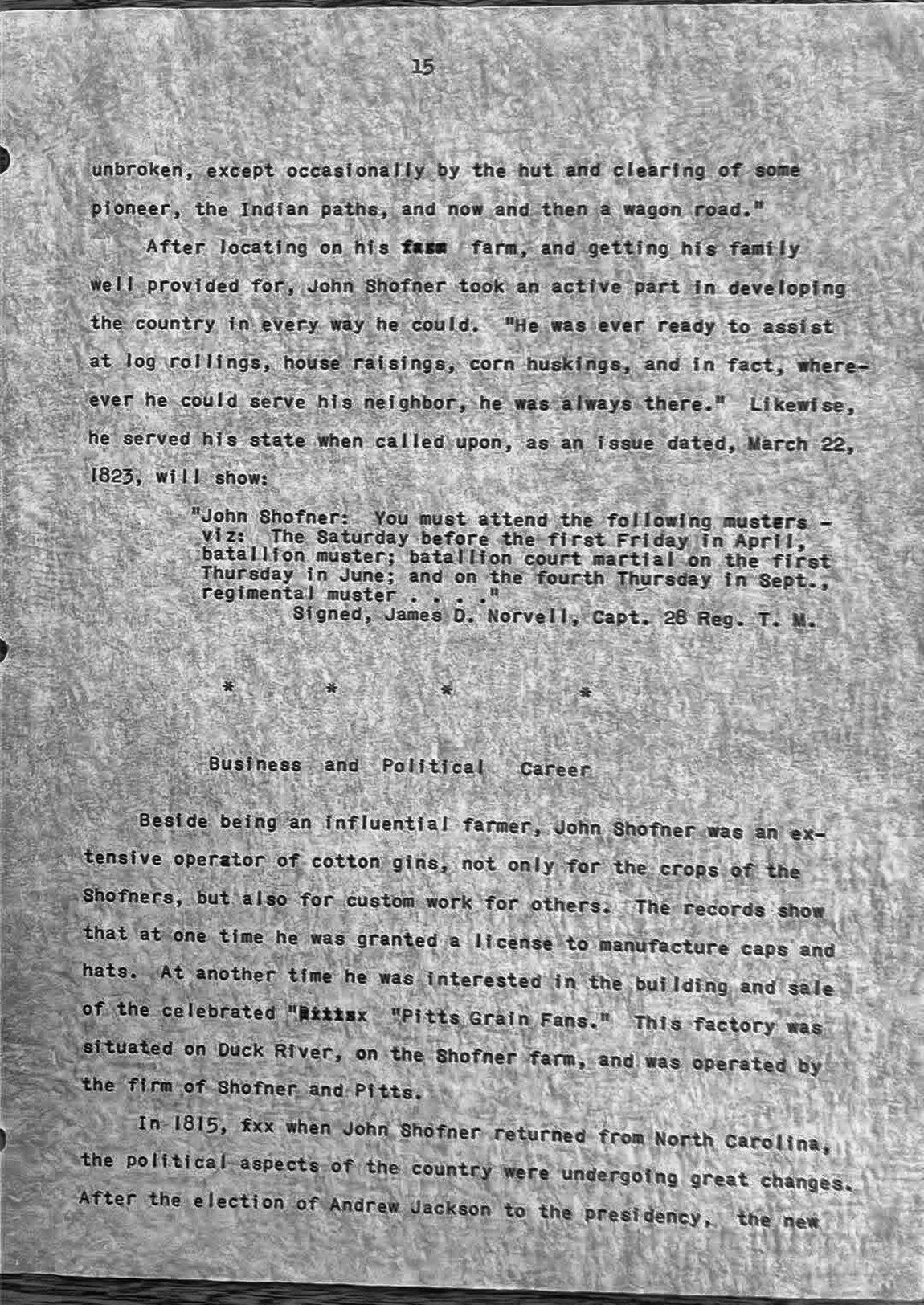
unbroken, except occasionally by the hut and clearing of some pioneer, the Indian paths, and now and then a wagon road.”
After locating on his farm, and getting his family well provided for, John Shofner took an active part in developing the country in every way he could. “He was ever ready to assist at log rollings, house raisings, corn huskings, and in fact, where-ever he could serve his neighbor, he was always there.” Likewise, he served his state when called upon, as an issue dated, March 22, 1823, will show:
“John Shofner: You must attend the following musters – viz: The Saturday before the first Friday in April, batallion muster; batallion court martial on the first Thursday in June; and on the fourth Thursday in Sept., regimental muster . . . .” Signed, James D. Norvell, Capt. 28 Reg. T. M.
* * * *
Business and Political Career
Beside being an influential farmer, John Shofner was an extensive operator of cotton gins, not only for the crops of the Shofners, but also for custom work for others. The records show that at one time he was granted a license to manufacture caps and hats. At another time he was interested in the building and sale of the celebrated “Pitts Grain Fans.” This factory was situated on Duck River, on the Shofner farm, and was operated by the firm of Shofner and Pitts.
In 1815, when John Shofner returned from North Carolina, the political aspects of the country were undergoing great changes. After the election of Andrew Jackson to the presidency, the new
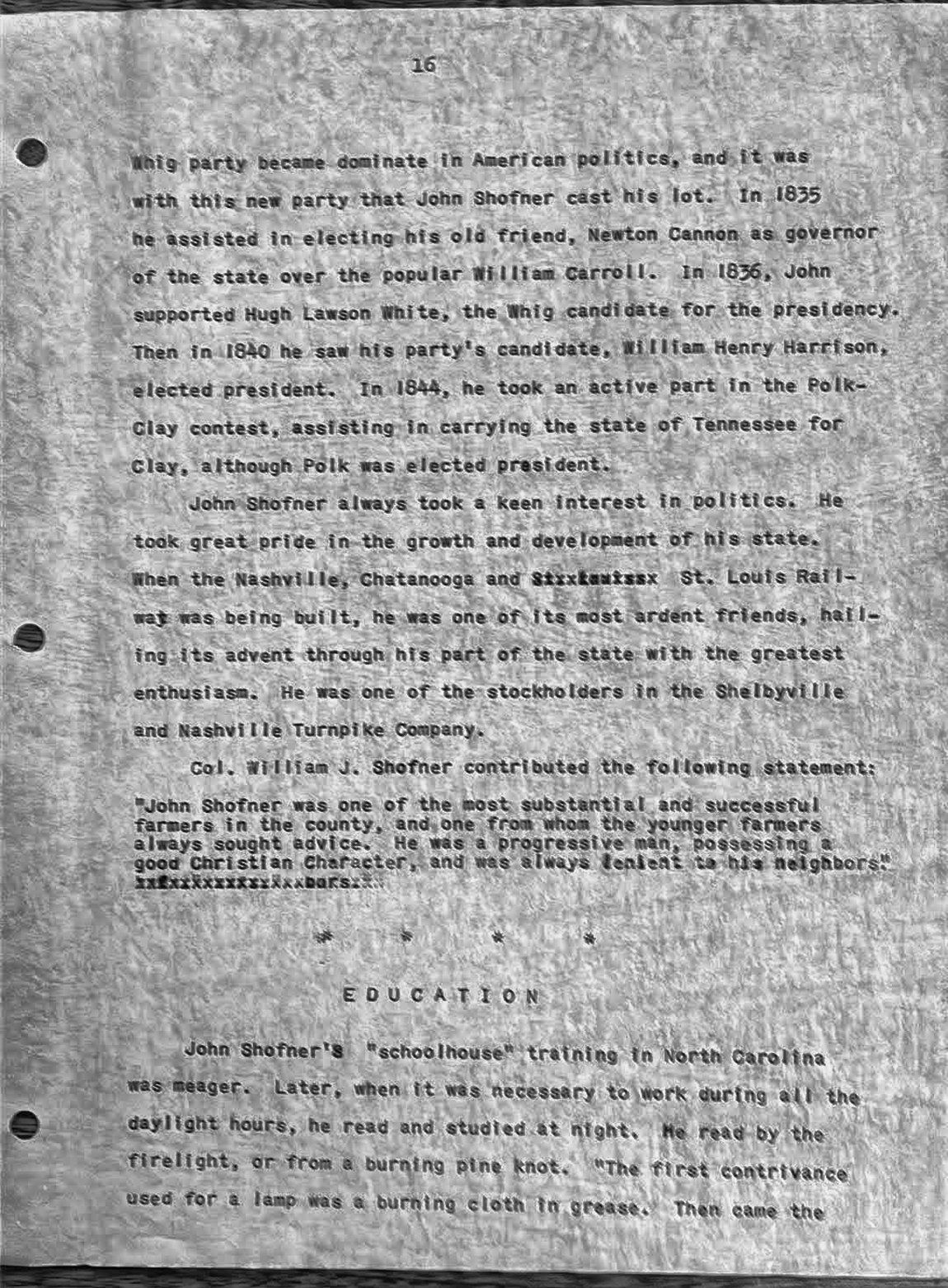
Whig party became dominate in American politics, and it was with this new party that John Shofner cast his lot. In 1835 he assisted in electing his old friend, Newton Cannon as governor of the state over the popular William Carroll. In 1836, John supported Hugh Lawson White, the Whig candidate for the presidency. Then in 1840 he saw his party’s candidate, William Henry Harrison, elected president. In 1844, he took an active part in the Polk-Clay contest, assisting in carrying the state of Tennessee for Clay, although Polk was elected president.
John Shofner always took a keen interest in politics. He took great pride in the growth and development of his state. When the Nashville, Chatanooga and St. Louis Railway was being built, he was one of its most ardent friends, hailing its advent through his part of the state with the greatest enthusiasm. He was one of the stockholders in the Shelbyville and Nashville Turnpike Company.
Col. William J. Shofner contributed the following statement:
“John Shofner was one of the most substantial and successful farmers in the county, and one from whom the younger farmers always sought advice. He was a progressive man, possessing a good Christian Character, and was always lenient to his neighbors.”
* * * *
EDUCATION
John Shofner’s “schoolhouse” training in North Carolina was meager. Later, when it was necessary to work during all the daylight hours, he read and studied at night. He read by the firelight, or from a burning pine knot. “The first contrivance used for a lamp was a burning cloth in grease. Then came the
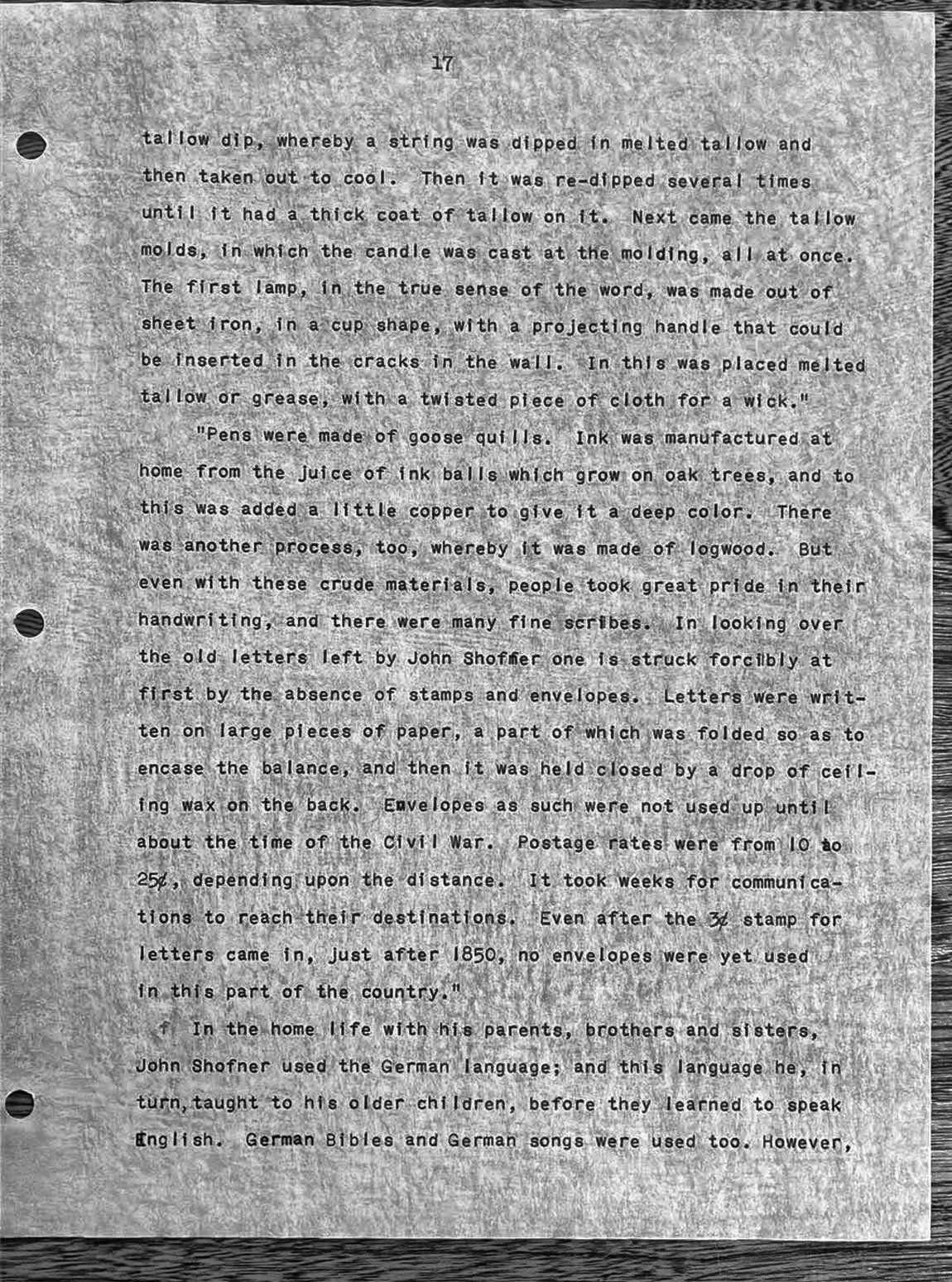
tallow dip, whereby a string was dipped in melted tallow and then taken out to cool. Then it was re-dipped several times until it had a thick coat of tallow on it. Next came the tallow molds, in which the candle was cast at the molding, all at once. The first lamp, in the true sense of the word, was made out of sheet iron, in a cup shape, with a projecting handle that could be inserted in the cracks in the wall. In this was placed melted tallow or grease, with a twisted piece of cloth for a wick.”
“Pens were made of goose quills. Ink was manufactured at home from the juice of ink balls which grow on oak trees, and to this was added a little copper to give it a deep color. There was another process, too, whereby it was made of logwood. But even with these crude materials, people took great pride in their handwriting, and there were many fine scribes. In looking over the old letters left by John Shofner one is struck forcibly at first by the absence of stamps and envelopes. Letters were written on large pieces of paper, a part of which was folded so as to encase the balance, and then it was held closed by a drop of ceiling wax on the back. Envelopes as such were not used up until about the time of the Civil War. Postage rates were from 10 to 25¢, depending upon the distance. It took weeks for communications to reach their destinations. Even after the 3¢ stamp for letters came in, just after 1850, no envelopes were yet used in this part of the country.”
In the home life with his parents, brothers and sisters, John Shofner used the German language; and this language he, in turn, taught to his older children, before they learned to speak English. German Bibles and German songs were used too. However,
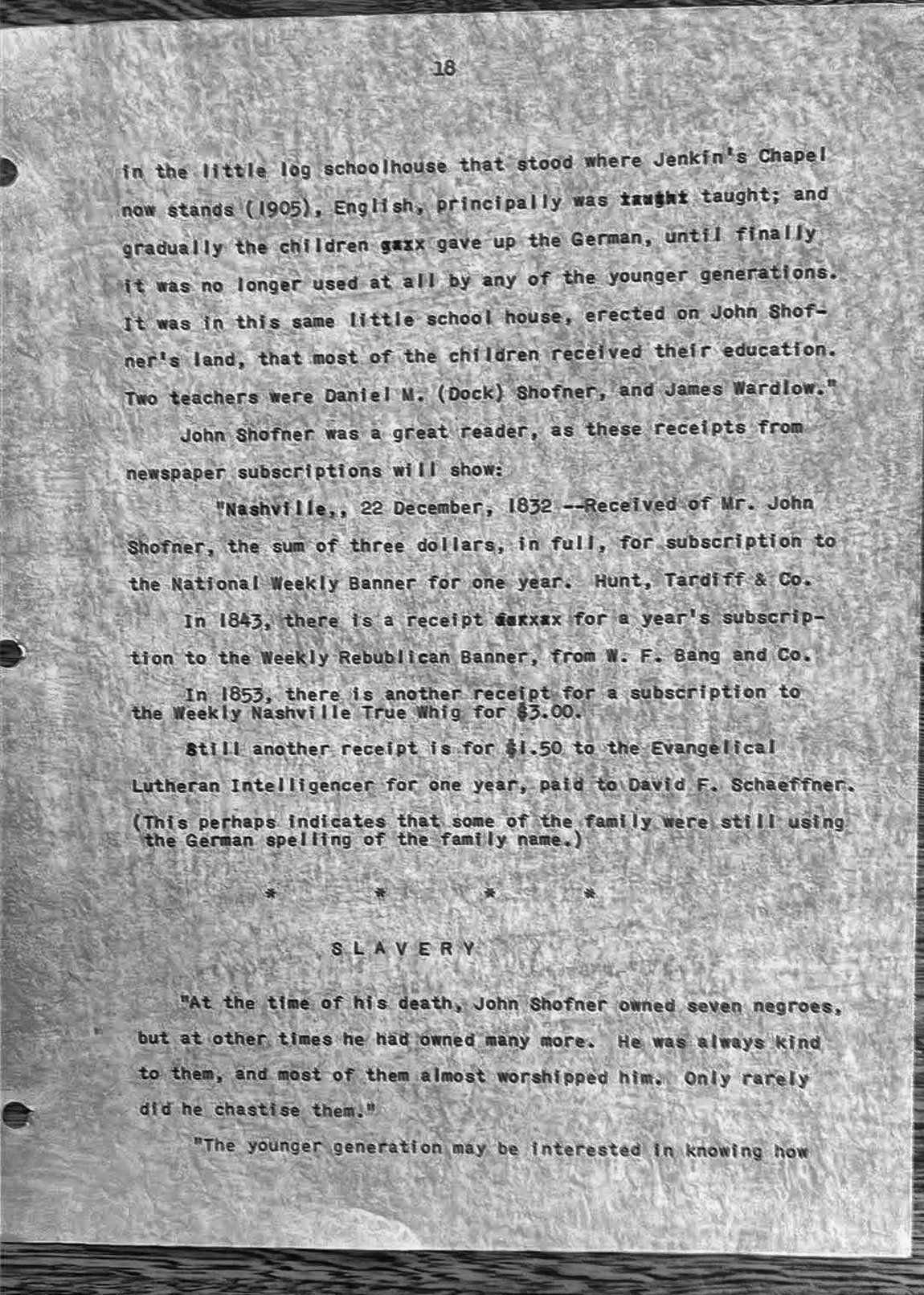
in the little log schoolhouse that stood where Jenkin’s Chapel now stands (1905), English, principally was taught; and gradually the children gave up the German, until finally it was no longer used at all by any of the younger generations. It was in this same little school house, erected on John Shofner’s land, that most of the children received their education. Two teachers were Daniel M. (Dock) Shofner, and James Wardlow.”
John Shofner was a great reader, as these receipts from newspaper subscriptions will show:
“Nashville, 22 December, 1832 – Received of Mr. John Shofner, the sum of three dollars, in full, for subscription to the National Weekly Banner for one year. Hunt, Tardiff & Co.”
In 1843, there is a receipt for a year’s subscription to the Weekly Rebublican Banner, from W. F. Bang and Co.
In 1853, there is another receipt for a subscription to the Weekly Nashville True Whig for $3.00.
Still another receipt is for $1.50 to the Evangelical Lutheran Intelligencer for one year, paid to David F. Schaeffner. (This perhaps indicates that some of the family were still using the German spelling of the family name.)
* * * *
SLAVERY
“At the time of his death, John Shofner owned seven negroes, but at other times he had owned many more. He was always kind to them, and most of them almost worshipped him. Only rarely did he chastise them.”
“The younger generation may be interested in knowing how
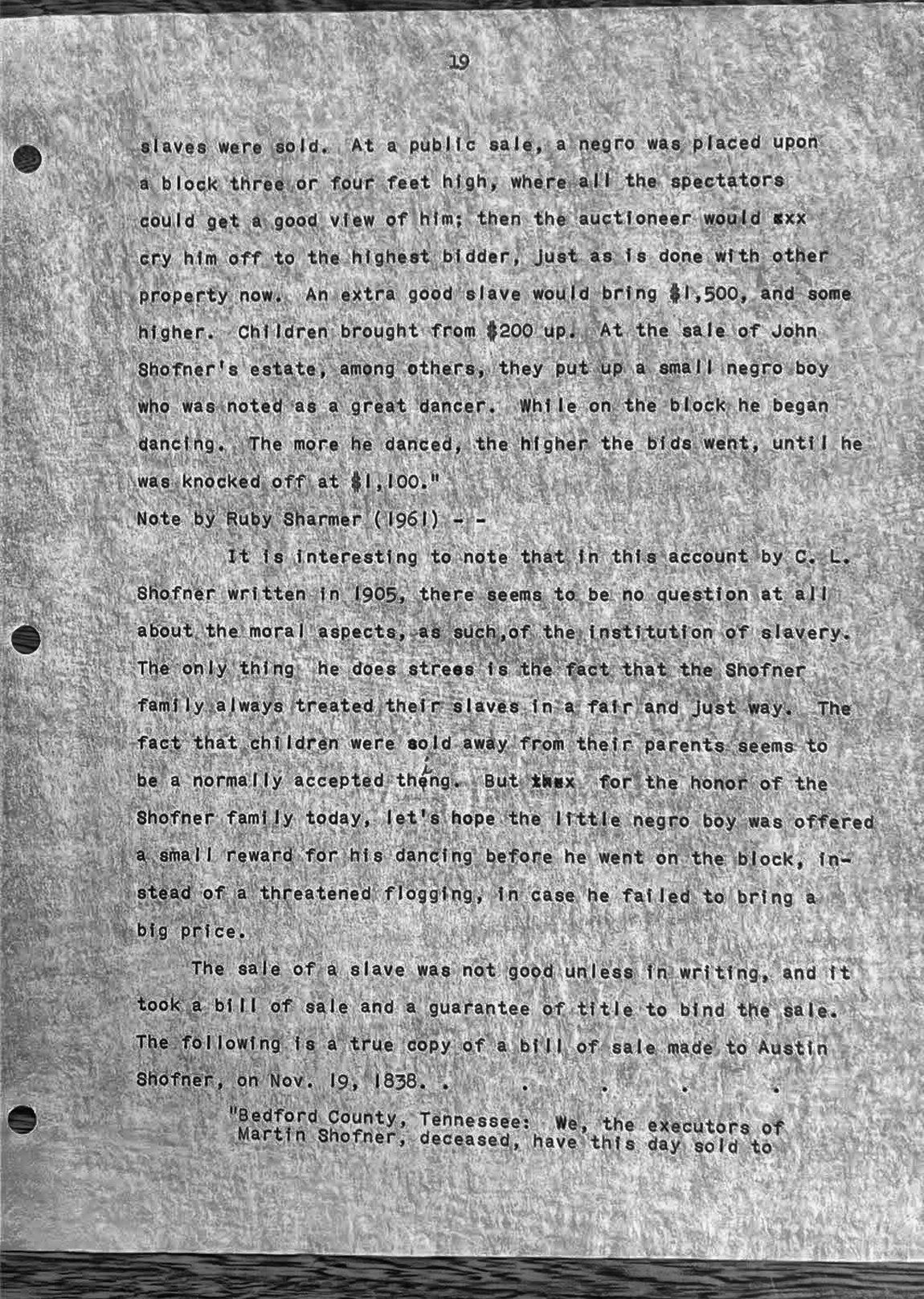
slaves were sold. At a public sale, a negro was placed upon a block three or four feet high, where all the spectators could get a good view of him; then the auctioneer would cry him off to the highest bidder, just as is done with other property now. An extra good slave would bring $1,500, and some higher. Children brought from $200 up. At the sale of John Shofner’s estate, among others, they put up a small negro boy who was noted as a great dancer. While on the block he began dancing. The more he danced, the higher the bids went, until he was knocked off at $1,100.”
Note by Ruby Sharmer (1961):
It is interesting to note that in this account by C. L. Shofner written in 1905, there seems to be no question at all about the moral aspects, as such, of the institution of slavery. The only thing he does stress is the fact that the Shofner family always treated their slaves in a fair and just way. The fact that children were sold away from their parents seems to be a normally accepted thing. But for the honor of the Shofner family today, let’s hope the little negro boy was offered a small reward for his dancing before he went on the block, instead of a threatened flogging, in case he failed to bring a big price.
The sale of a slave was not good unless in writing, and it took a bill of sale and a guarantee of title to bind the sale. The following is a true copy of a bill of sale made to Austin Shofner, on Nov. 19, 1838. . . .
“Bedford County, Tennessee: We, the executors of Martin Shofner, deceased, have this day sold to
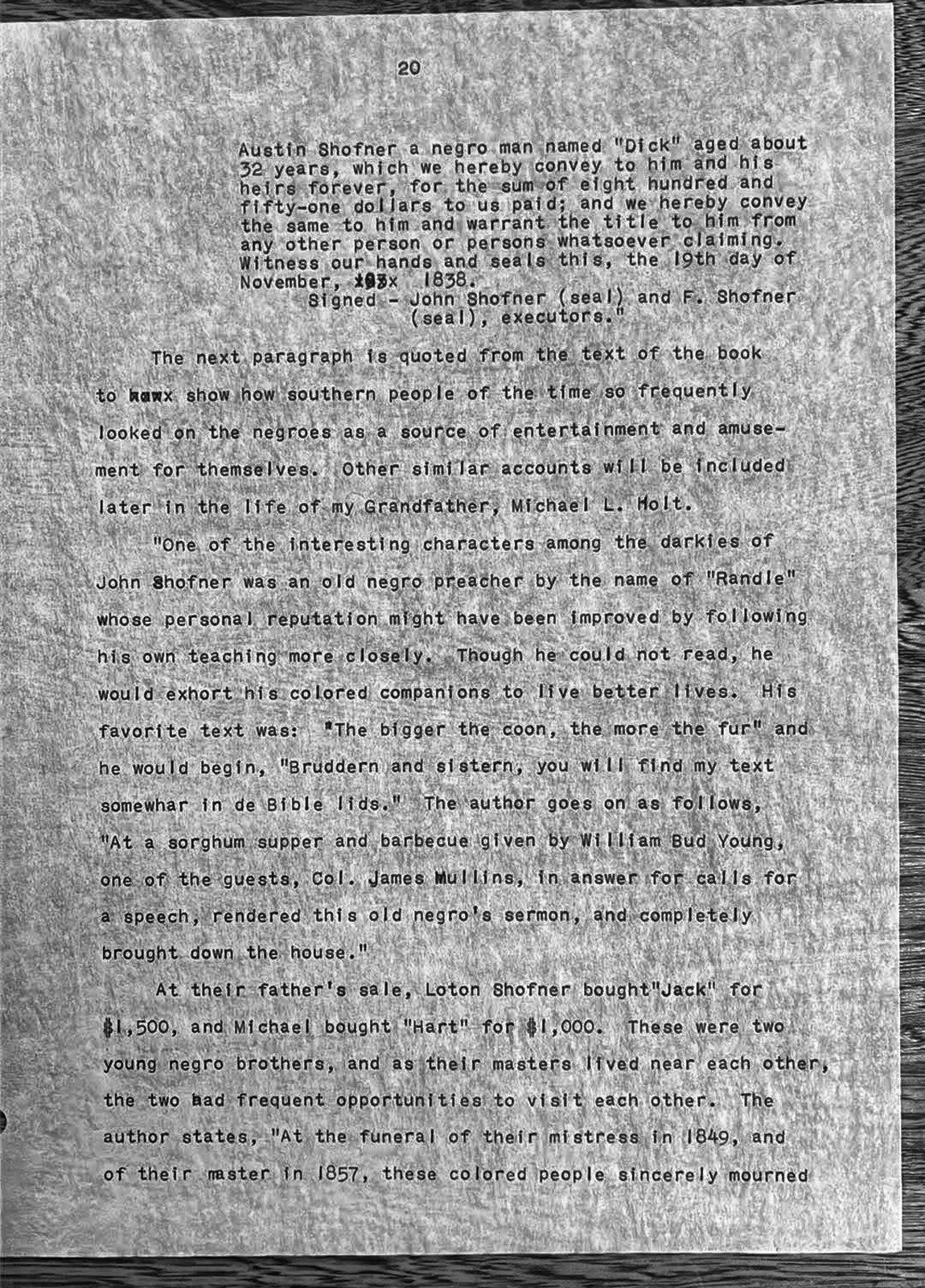
Austin Shofner a negro man named “Dick” aged about 32 years, which we hereby convey to him and his heirs forever, for the sum of eight hundred and fifty-one dollars to us paid; and we hereby convey the same to him and warrant the title to him from any other person or persons whatsoever claiming. Witness our hands and seals this, the 19th day of November, 1838. Signed – John Shofner (seal) and F. Shofner (seal), executors.”
The next paragraph is quoted from the text of the book to show how southern people of the time so frequently looked on the negroes as a source of entertainment and amusement for themselves. Other similar accounts will be included later in the life of my Grandfather, Michael L. Holt.
“One of the interesting characters among the darkies of John Shofner was an old negro preacher by the name of “Randle” whose personal reputation might have been improved by following his own teaching more closely. Though he could not read, he would exhort his colored companions to live better lives. His favorite text was: “The bigger the coon, the more the fur” and he would begin, “Bruddern and sistern, you will find my text somewhar in de Bible lids.” The author goes on as follows, “At a sorghum supper and barbecue given by William Bud Young, one of the guests, Col. James Mullins, in answer for calls for a speech, rendered this old negro’s sermon, and completely brought down the house.”
At their father’s sale, Loton Shofner bought “Jack” for $1,500, and Michael bought “Hart” for $1,000. These were two young negro brothers, and as their masters lived near each other, the two had frequent opportunities to visit each other. The author states, “At the funeral of their mistress in 1849, and of their master in 1857, these colored people sincerely mourned
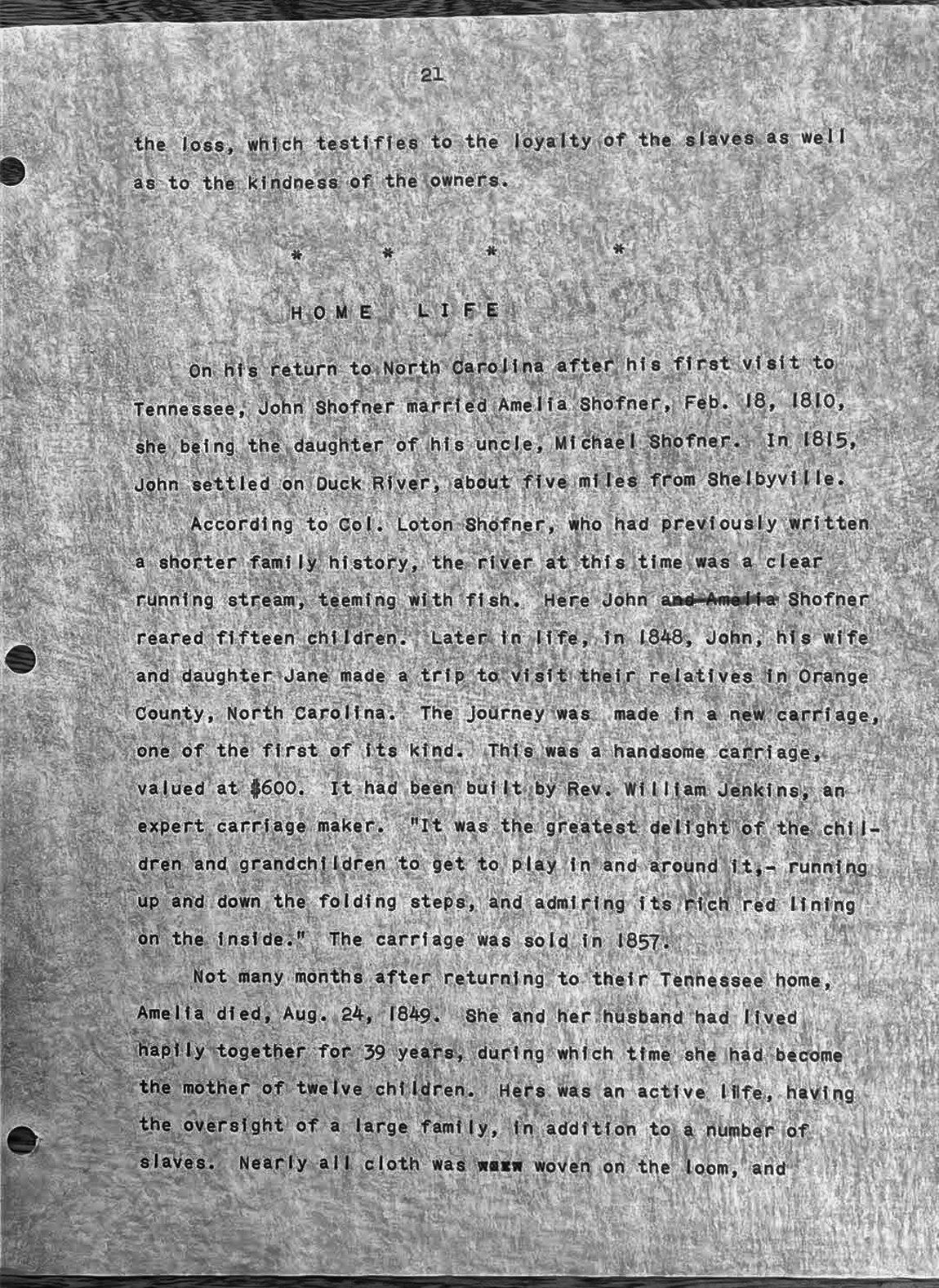
the loss, which testifies to the loyalty of the slaves as well as to the kindness of the owners.
* * * *
HOME LIFE
On his return to North Carolina after his first visit to Tennessee, John Shofner married Amelia Shofner, Feb. 18, 1810, she being the daughter of his uncle, Michael Shofner. In 1815, John settled on Duck River, about five miles from Shelbyville.
According to Col. Loton Shofner, who had previously written a shorter family history, the river at this time was a clear running stream, teeming with fish. Here John and Amelia Shofner reared fifteen children. Later in life, in 1848, John, his wife and daughter Jane made a trip to visit their relatives in Orange County, North Carolina. The journey was made in a new carriage, one of the first of its kind. This was a handsome carriage, valued at $600. It had been built by Rev. William Jenkins, an expert carriage maker. “It was the greatest delight of the children and grandchildren to get to play in and around it, – running up and down the folding steps, and admiring its rich red lining on the inside.” The carriage was sold in 1857.
Not many months after returning to their Tennessee home, Amelia died, Aug. 24, 1849. She and her husband had lived happily together for 39 years, during which time she had become the mother of twelve children. Hers was an active life, having the oversight of a large family, in addition to a number of slaves. Nearly all cloth was woven on the loom, and
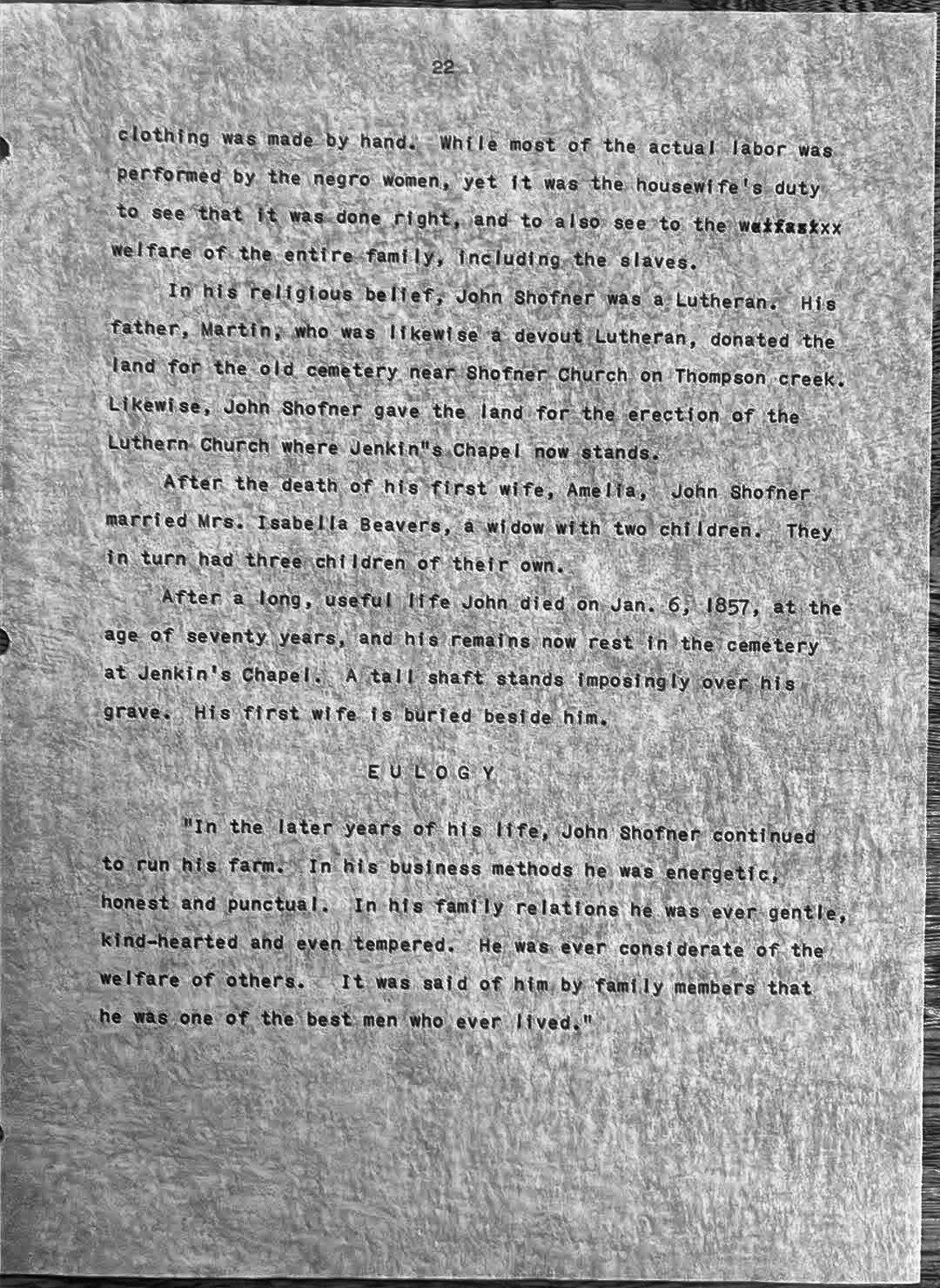
clothing was made by hand. While most of the actual labor was performed by the negro women, yet it was the housewife’s duty to see that it was done right, and to also see to the welfare of the entire family, including the slaves.
In his religious belief, John Shofner was a Lutheran. His father, Martin, who was likewise a devout Lutheran, donated the land for the old cemetery near Shofner Church on Thompson creek. Likewise, John Shofner gave the land for the erection of the Luthern Church where Jenkin’s Chapel now stands.
After the death of his first wife, Amelia, John Shofner married Mrs. Isabella Beavers, a widow with two children. They in turn had three children of their own.
After a long, useful life John died on Jan. 6, 1857, at the age of seventy years, and his remains now rest in the cemetery at Jenkin’s Chapel. A tall shaft stands imposingly over his grave. His first wife is buried beside him.
EULOGY
“In the later years of his life, John Shofner continued to run his farm. In his business methods he was energetic, honest and punctual. In his family relations he was ever gentle, kind-hearted and even tempered. He was ever considerate of the welfare of others. It was said of him by family members that he was one of the best men who ever lived.”
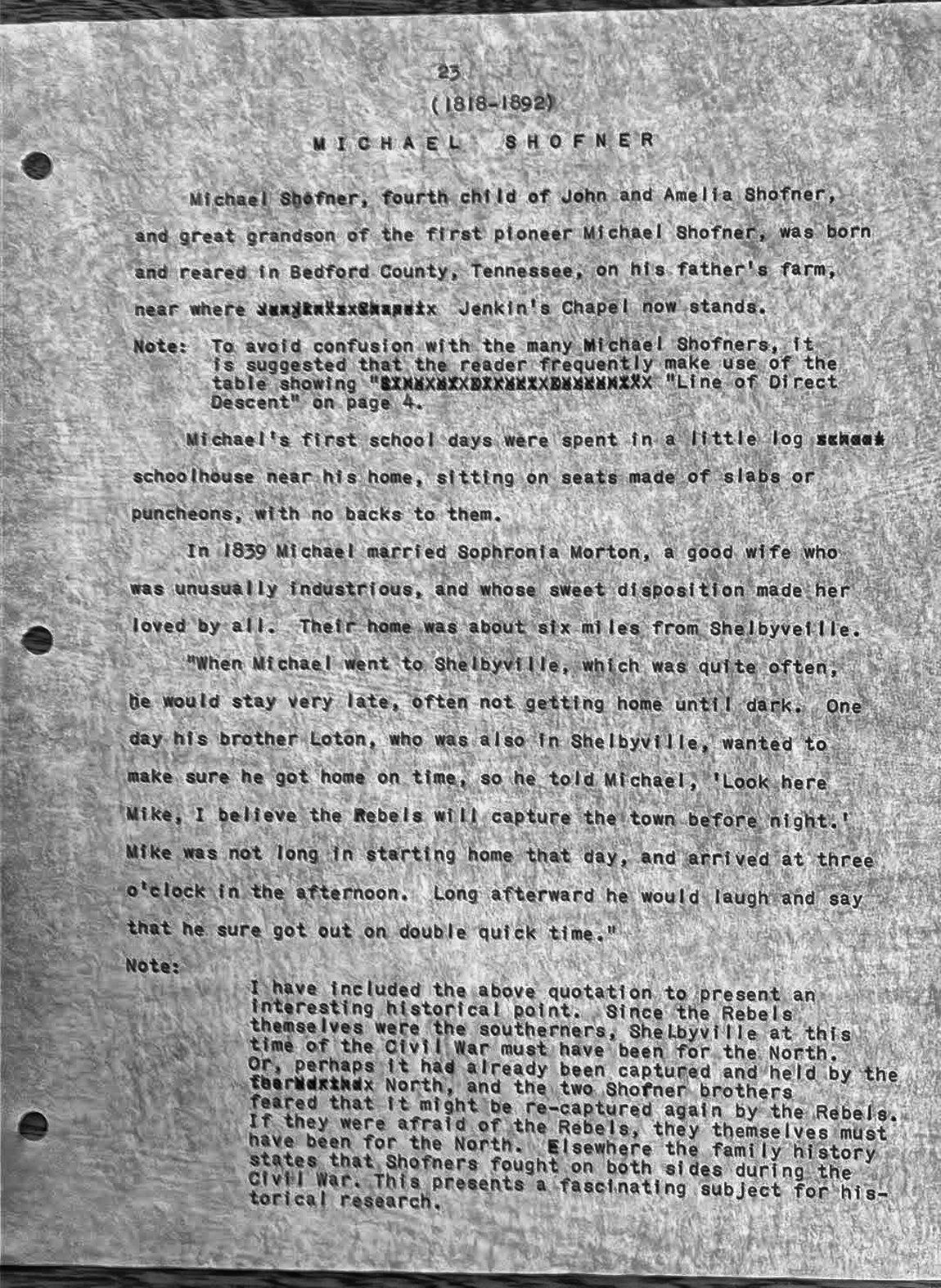
MICHAEL SHOFNER (1818–1892)
Michael Shofner, fourth child of John and Amelia Shofner, and great grandson of the first pioneer Michael Shofner, was born and reared in Bedford County, Tennessee, on his father’s farm, near where Jenkin’s Chapel now stands.
Note: To avoid confusion with the many Michael Shofners, it is suggested that the reader frequently make use of the table showing “Line of Direct Descent” on page 4.
Michael’s first school days were spent in a little log schoolhouse near his home, sitting on seats made of slabs or puncheons, with no backs to them.
In 1839 Michael married Sophronia Morton, a good wife who was unusually industrious, and whose sweet disposition made her loved by all. Their home was about six miles from Shelbyveille.
“When Michael went to Shelbyville, which was quite often, he would stay very late, often not getting home until dark. One day his brother Loton, who was also in Shelbyville, wanted to make sure he got home on time, so he told Michael, ‘Look here Mike, I believe the Rebels will capture the town before night.’ Mike was not long in starting home that day, and arrived at three o’clock in the afternoon. Long afterward he would laugh and say that he sure got out on double quick time.”
Note: I have included the above quotation to present an interesting historical point. Since the Rebels themselves were the southerners, Shelbyville at this time of the Civil War must have been for the North. Or, perhaps it had already been captured and held by the North, and the two Shofner brothers feared that it might be re-captured again by the Rebels. If they were afraid of the Rebels, they themselves must have been for the North. Elsewhere the family history states that Shofners fought on both sides during the Civil War. This presents a fascinating subject for historical research.
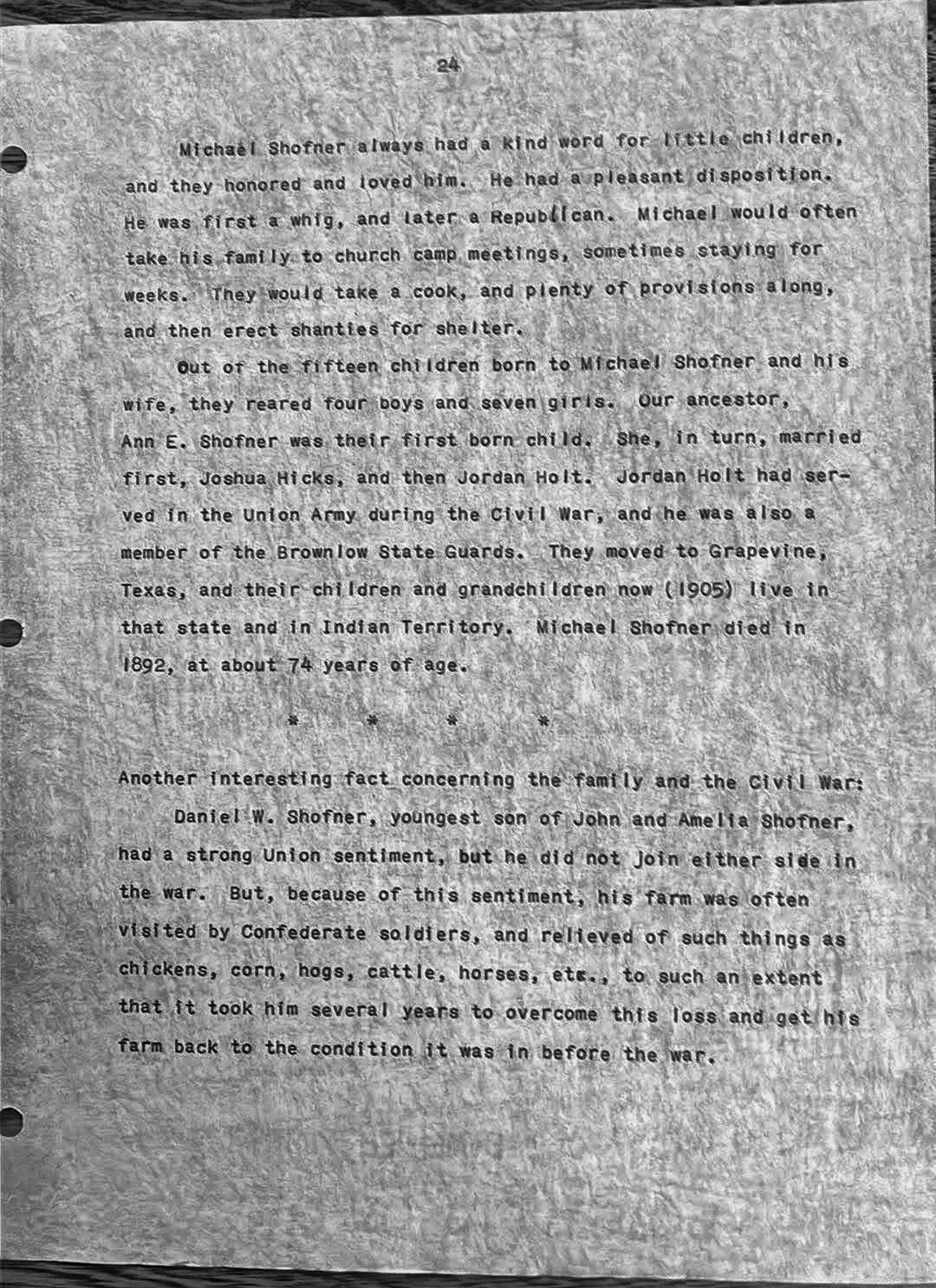
Michael Shofner always had a kind word for little children, and they honored and loved him. He had a pleasant disposition. He was first a whig, and later a Republican. Michael would often take his family to church camp meetings, sometimes staying for weeks. They would take a cook, and plenty of provisions along, and then erect shanties for shelter.
Out of the fifteen children born to Michael Shofner and his wife, they reared four boys and seven girls. Our ancestor, Ann E. Shofner was their first born child. She, in turn, married first, Joshua Hicks, and then Jordan Holt. Jordan Holt had served in the Union Army during the Civil War, and he was also a member of the Brownlow State Guards. They moved to Grapevine, Texas, and their children and grandchildren now (1905) live in that state and in Indian Territory. Michael Shofner died in 1892, at about 74 years of age.
* * * *
Another interesting fact concerning the family and the Civil War:
Daniel W. Shofner, youngest son of John and Amelia Shofner, had a strong Union sentiment, but he did not join either side in the war. But, because of this sentiment, his farm was often visited by Confederate soldiers, and relieved of such things as chickens, corn, hogs, cattle, horses, etc., to such an extent that it took him several years to overcome this loss and get his farm back to the condition it was in before the war.
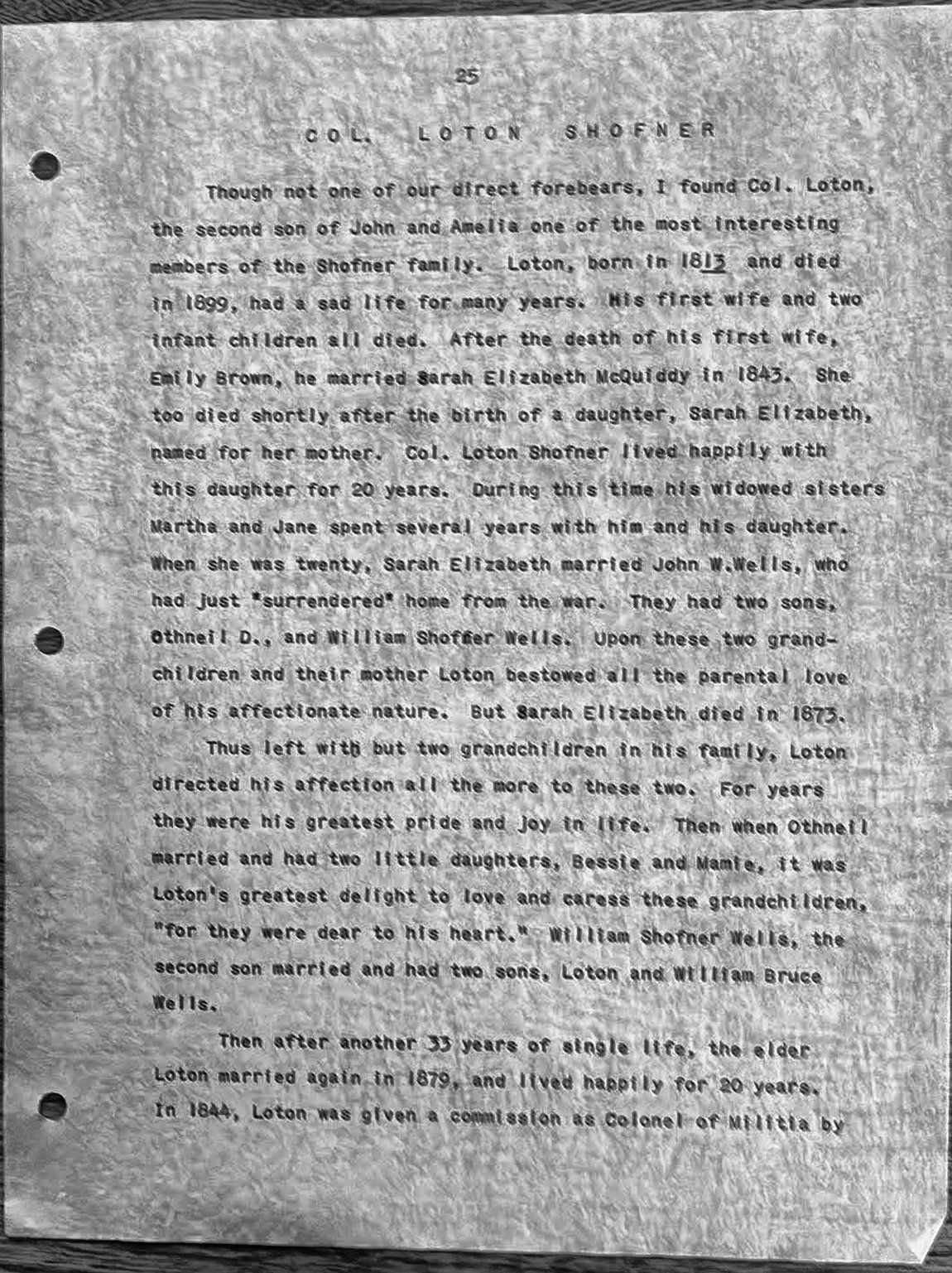
COL. LOTON SHOFNER
Though not one of our direct forebears, I found Col. Loton, the second son of John and Amelia one of the most interesting members of the Shofner family. Loton, born in 1813 and died in 1899, had a sad life for many years. His first wife and two infant children all died. After the death of his first wife, Emily Brown, he married Sarah Elizabeth McQuiddy in 1843. She too died shortly after the birth of a daughter, Sarah Elizabeth, named for her mother. Col. Loton Shofner lived happily with this daughter for 20 years. During this time his widowed sisters Martha and Jane spent several years with him and his daughter. When she was twenty, Sarah Elizabeth married John W. Wells, who had just “surrendered” home from the war. They had two sons, Othneil D., and William Shofner Wells. Upon these two grandchildren and their mother Loton bestowed all the parental love of his affectionate nature. But Sarah Elizabeth died in 1873.
Thus left with but two grandchildren in his family, Loton directed his affection all the more to these two. For years they were his greatest pride and joy in life. Then when Othneil married and had two little daughters, Bessie and Mamie, it was Loton’s greatest delight to love and caress these grandchildren, “for they were dear to his heart.” William Shofner Wells, the second son married and had two sons, Loton and William Bruce Wells.
Then after another 33 years of single life, the elder Loton married again in 1879, and lived happily for 20 years. In 1844, Loton was given a commission as Colonel of Militia by
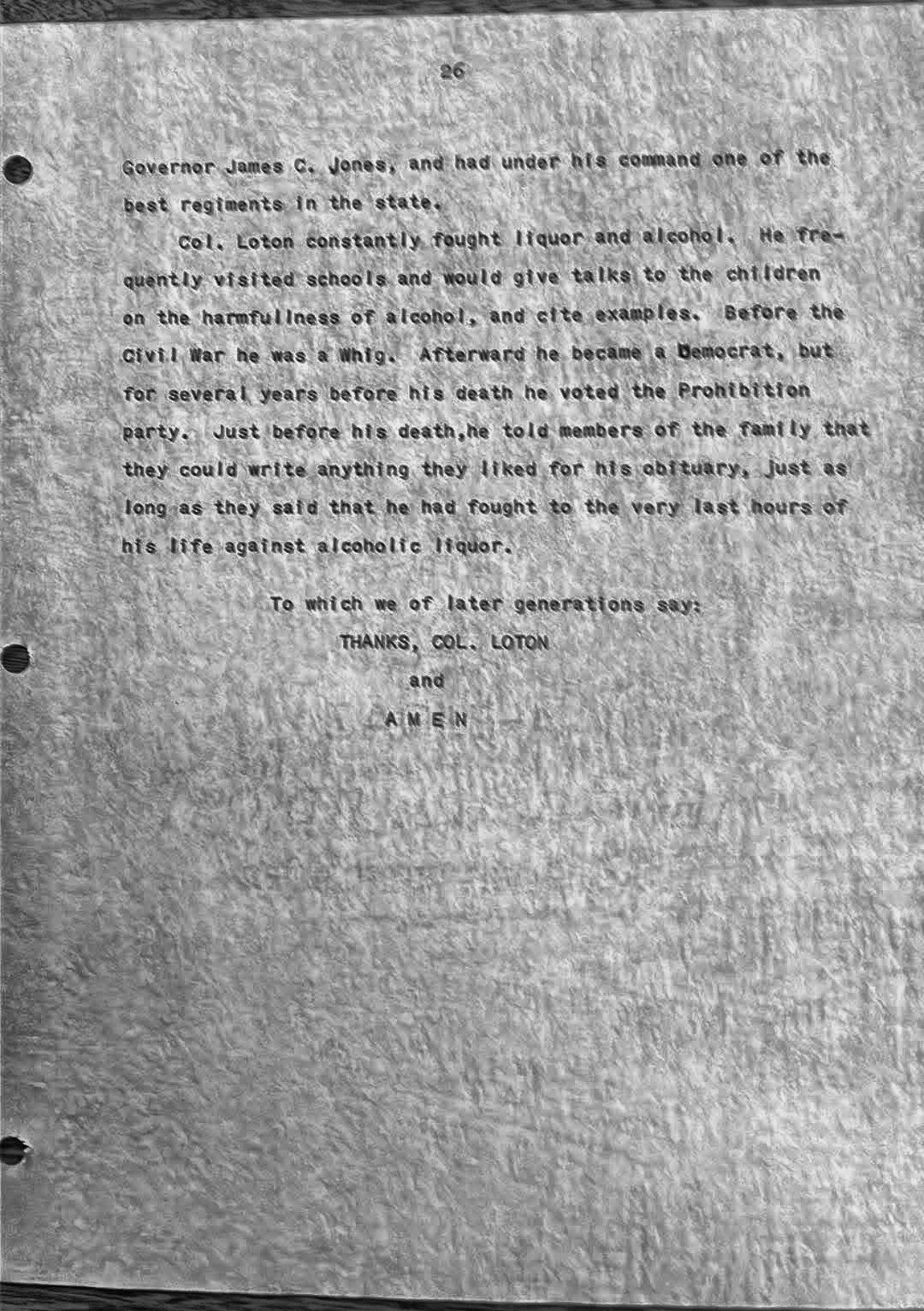
Governor James C. Jones, and had under his command one of the best regiments in the state.
Col. Loton constantly fought liquor and alcohol. He frequently visited schools and would give talks to the children on the harmfulness of alcohol, and cite examples. Before the Civil War he was a Whig. Afterward he became a Democrat, but for several years before his death he voted the Prohibition party. Just before his death, he told members of the family that they could write anything they liked for his obituary, just as long as they said that he had fought to the very last hours of his life against alcoholic liquor.
To which we of later generations say: THANKS, COL. LOTON and AMEN
Scans courtesy of Laurel Sharmer. Original typed by Ruby Evangeline Wilson Sharmer, January 1962.

