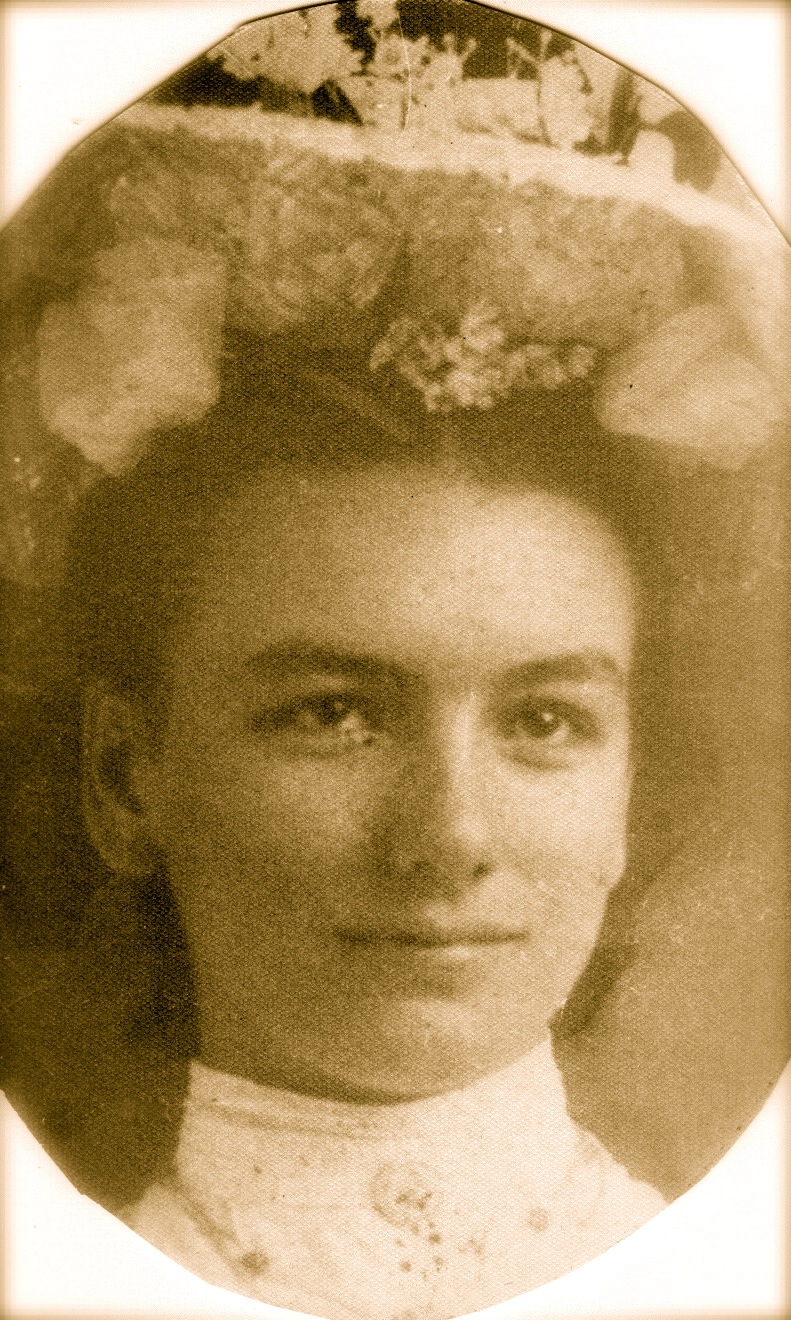
The last chapter of Family Records, 1962: the first part of an autobiography written by Ruby’s mother, Nettie Ann Holt Wilson, in March 1951. Nettie was born on February 14, 1890, near Paradise, in Wise County, Texas, and grew up on the Holt ranch in Taylor County. She writes about school and church, her father’s blacksmith shop, chores, games and punishments, and the move to California by train when she was 15, when her father sold the ranch for $12.50 an acre and bought land in California for $25 an acre.
In brief
- Nettie was born near Paradise, Wise County, in 1890 and grew up on the family’s 1,300-acre ranch near Guion, 25 miles from town.
- She milked cows at seven, drove teams and farm machinery, and at eleven was nearly trampled when a team ran away with a threshing machine.
- Her father was a blacksmith who shod the neighbors’ horses and made coffins when anyone died.
- Treats were wild plum jelly, vinegar pies and popcorn eaten with sugar and milk; she was sixteen before the house had a bathtub.
- When she was 15 the family sold the ranch for $12.50 an acre and moved by train to Planada, California, buying land there at $25 an acre.
How to read this transcription: each typed page is shown beside its scan (tap a scan to see it full size). Highlighted words were written in by hand on the typed page; [square brackets] are our notes; spelling is kept as typed.
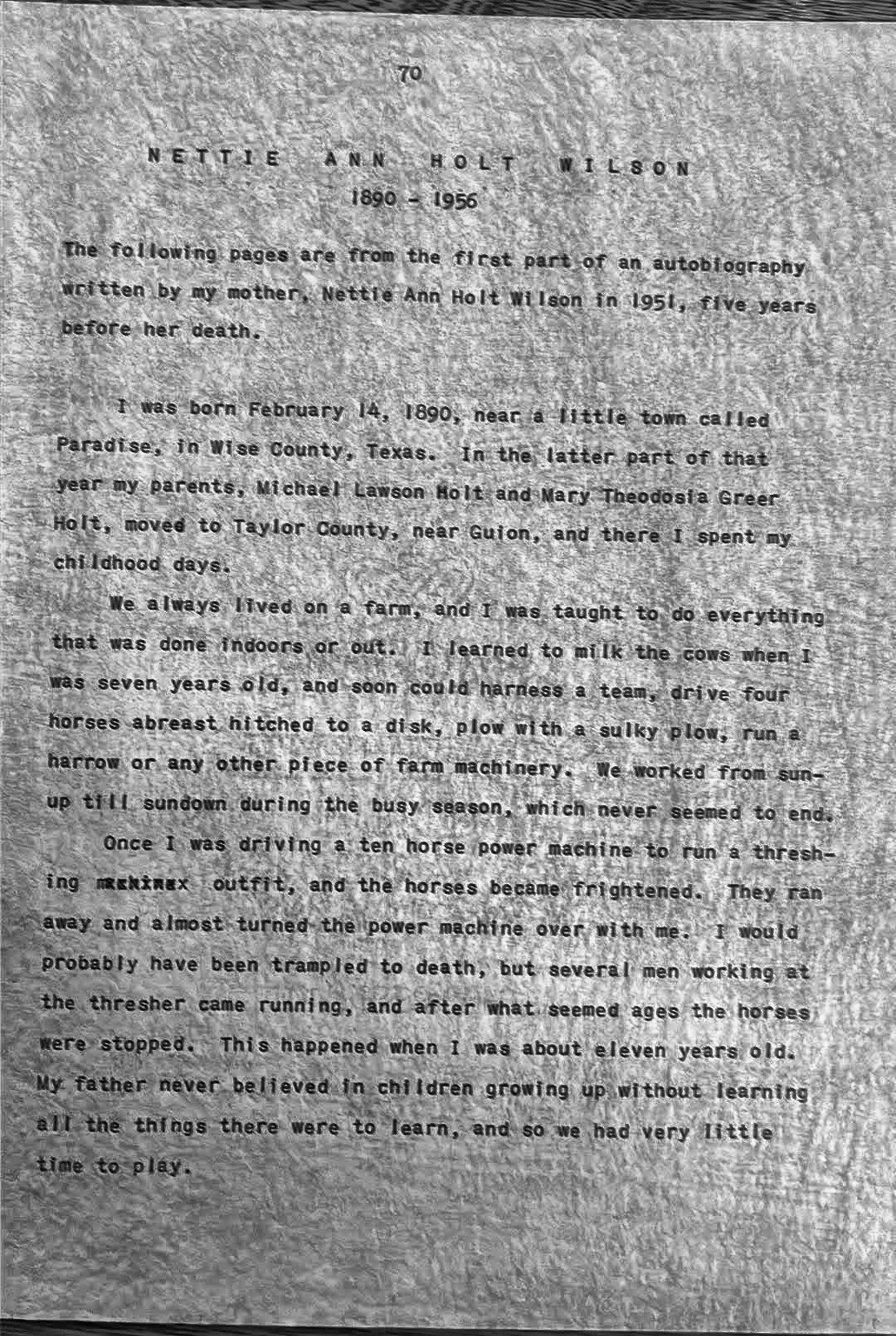
NETTIE ANN HOLT WILSON, 1890 – 1956
The following pages are from the first part of an autobiography written by my mother, Nettie Ann Holt Wilson in 1951, five years before her death.
I was born February 14, 1890, near a little town called Paradise, in Wise County, Texas. In the latter part of that year my parents, Michael Lawson Holt and Mary Theodosia Greer Holt, moved to Taylor County, near Guion, and there I spent my childhood days.
We always lived on a farm, and I was taught to do everything that was done indoors or out. I learned to milk the cows when I was seven years old, and soon could harness a team, drive four horses abreast hitched to a disk, plow with a sulky plow, run a harrow or any other piece of farm machinery. We worked from sun-up till sundown during the busy season, which never seemed to end.
Once I was driving a ten horse power machine to run a threshing outfit, and the horses became frightened. They ran away and almost turned the power machine over with me. I would probably have been trampled to death, but several men working at the thresher came running, and after what seemed ages the horses were stopped. This happened when I was about eleven years old. My father never believed in children growing up without learning all the things there were to learn, and so we had very little time to play.
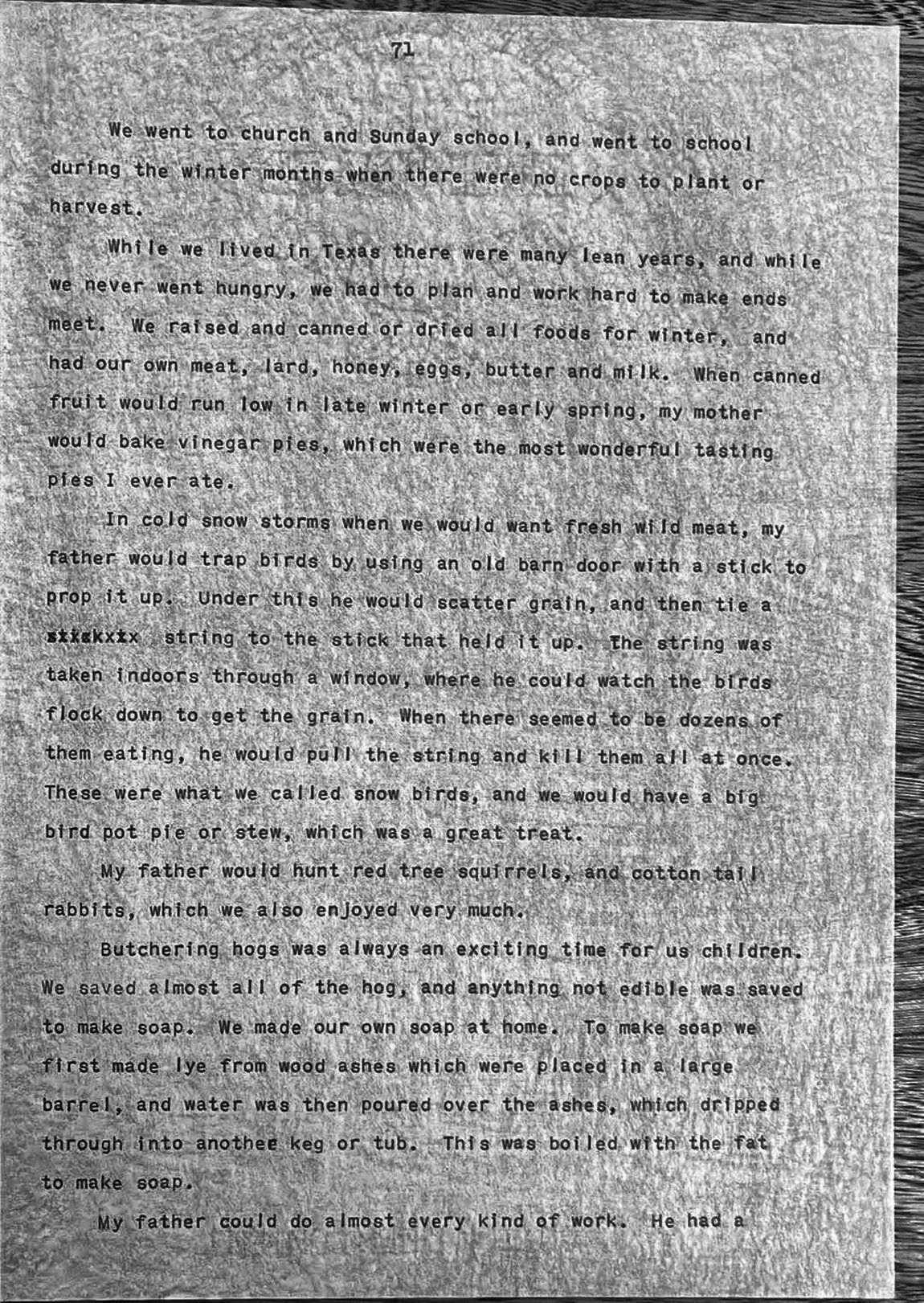
We went to church and Sunday school, and went to school during the winter months when there were no crops to plant or harvest.
While we lived in Texas there were many lean years, and while we never went hungry, we had to plan and work hard to make ends meet. We raised and canned or dried all foods for winter, and had our own meat, lard, honey, eggs, butter and milk. When canned fruit would run low in late winter or early spring, my mother would bake vinegar pies, which were the most wonderful tasting pies I ever ate.
In cold snow storms when we would want fresh wild meat, my father would trap birds by using an old barn door with a stick to prop it up. Under this he would scatter grain, and then tie a string to the stick that held it up. The string was taken indoors through a window, where he could watch the birds flock down to get the grain. When there seemed to be dozens of them eating, he would pull the string and kill them all at once. These were what we called snow birds, and we would have a big bird pot pie or stew, which was a great treat.
My father would hunt red tree squirrels, and cotton tail rabbits, which we also enjoyed very much.
Butchering hogs was always an exciting time for us children. We saved almost all of the hog, and anything not edible was saved to make soap. We made our own soap at home. To make soap we first made lye from wood ashes which were placed in a large barrel, and water was then poured over the ashes, which dripped through into another keg or tub. This was boiled with the fat to make soap.
My father could do almost every kind of work. He had a
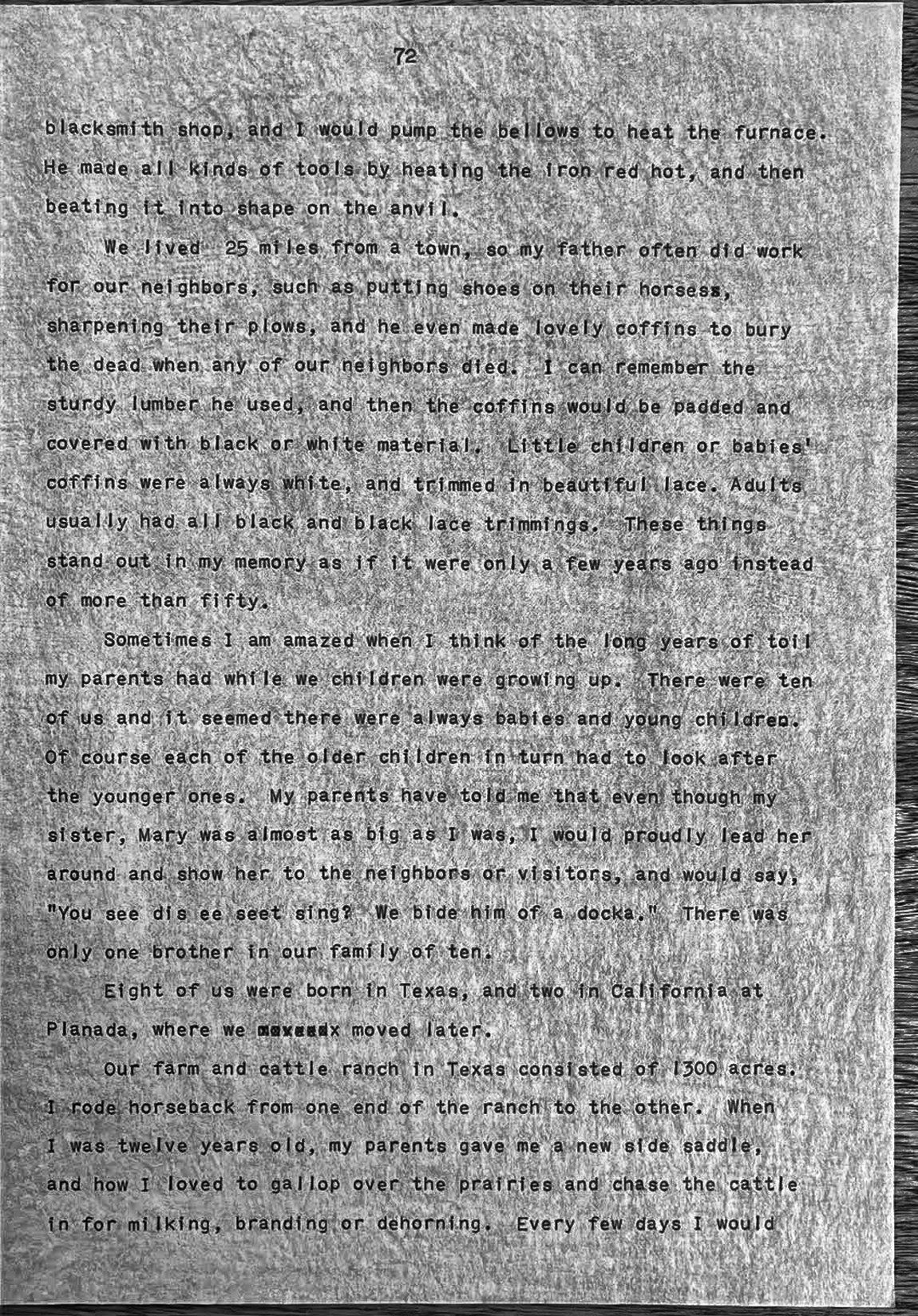
blacksmith shop, and I would pump the bellows to heat the furnace. He made all kinds of tools by heating the iron red hot, and then beating it into shape on the anvil.
We lived 25 miles from a town, so my father often did work for our neighbors, such as putting shoes on their horses, sharpening their plows, and he even made lovely coffins to bury the dead when any of our neighbors died. I can remember the sturdy lumber he used, and then the coffins would be padded and covered with black or white material. Little children or babies’ coffins were always white, and trimmed in beautiful lace. Adults usually had all black and black lace trimmings. These things stand out in my memory as if it were only a few years ago instead of more than fifty.
Sometimes I am amazed when I think of the long years of toil my parents had while we children were growing up. There were ten of us and it seemed there were always babies and young children. Of course each of the older children in turn had to look after the younger ones. My parents have told me that even though my sister, Mary was almost as big as I was, I would proudly lead her around and show her to the neighbors or visitors, and would say, “You see dis ee seet sing? We bide him of a docka.” There was only one brother in our family of ten.
Eight of us were born in Texas, and two in California at Planada, where we moved later.
Our farm and cattle ranch in Texas consisted of 1300 acres. I rode horseback from one end of the ranch to the other. When I was twelve years old, my parents gave me a new side saddle, and how I loved to gallop over the prairies and chase the cattle in for milking, branding or dehorning. Every few days I would
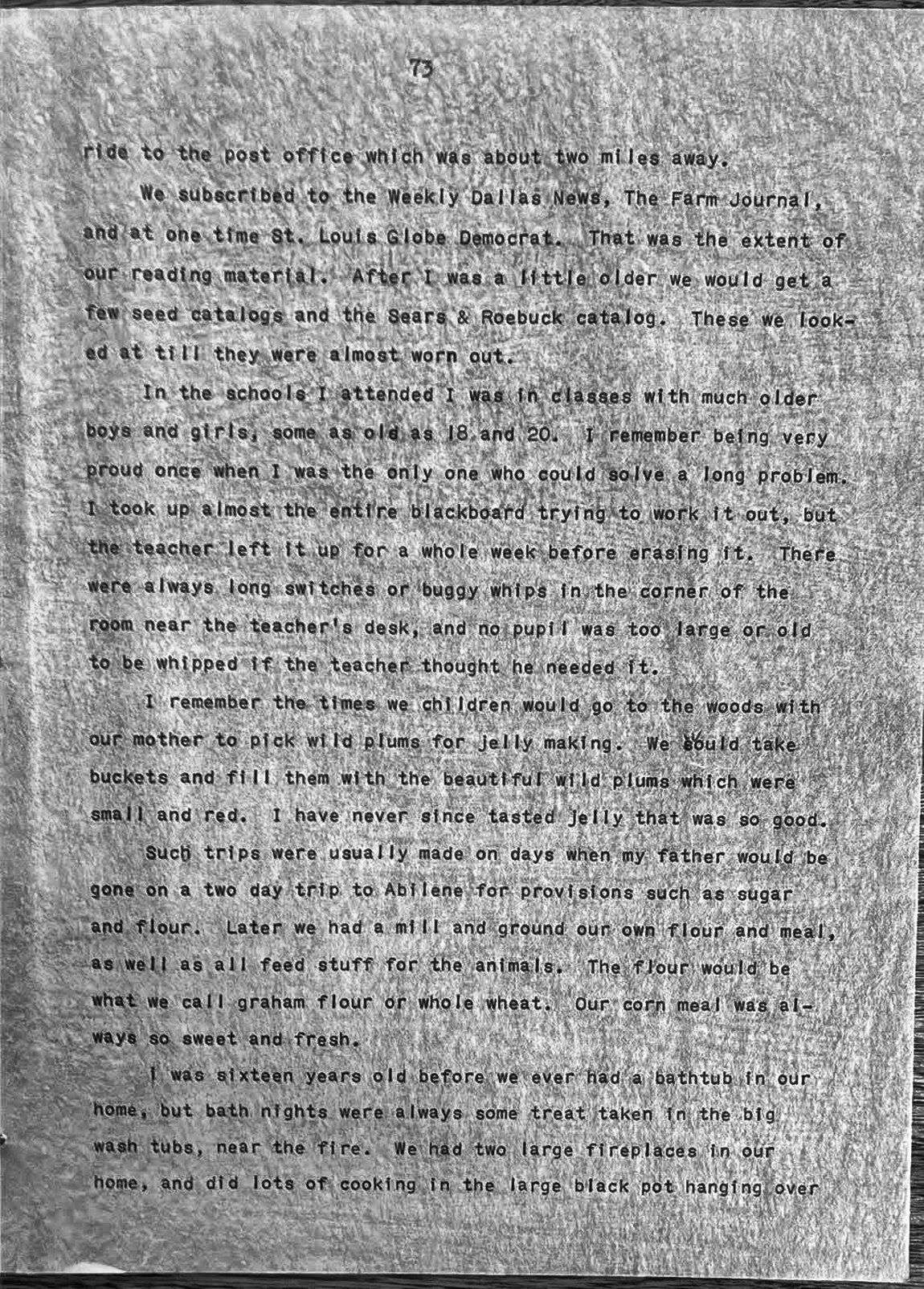
ride to the post office which was about two miles away.
We subscribed to the Weekly Dallas News, The Farm Journal, and at one time St. Louis Globe Democrat. That was the extent of our reading material. After I was a little older we would get a few seed catalogs and the Sears & Roebuck catalog. These we looked at till they were almost worn out.
In the schools I attended I was in classes with much older boys and girls, some as old as 18 and 20. I remember being very proud once when I was the only one who could solve a long problem. I took up almost the entire blackboard trying to work it out, but the teacher left it up for a whole week before erasing it. There were always long switches or buggy whips in the corner of the room near the teacher’s desk, and no pupil was too large or old to be whipped if the teacher thought he needed it.
I remember the times we children would go to the woods with our mother to pick wild plums for jelly making. We would take buckets and fill them with the beautiful wild plums which were small and red. I have never since tasted jelly that was so good.
Such trips were usually made on days when my father would be gone on a two day trip to Abilene for provisions such as sugar and flour. Later we had a mill and ground our own flour and meal, as well as all feed stuff for the animals. The flour would be what we call graham flour or whole wheat. Our corn meal was always so sweet and fresh.
I was sixteen years old before we ever had a bathtub in our home, but bath nights were always some treat taken in the big wash tubs, near the fire. We had two large fireplaces in our home, and did lots of cooking in the large black pot hanging over
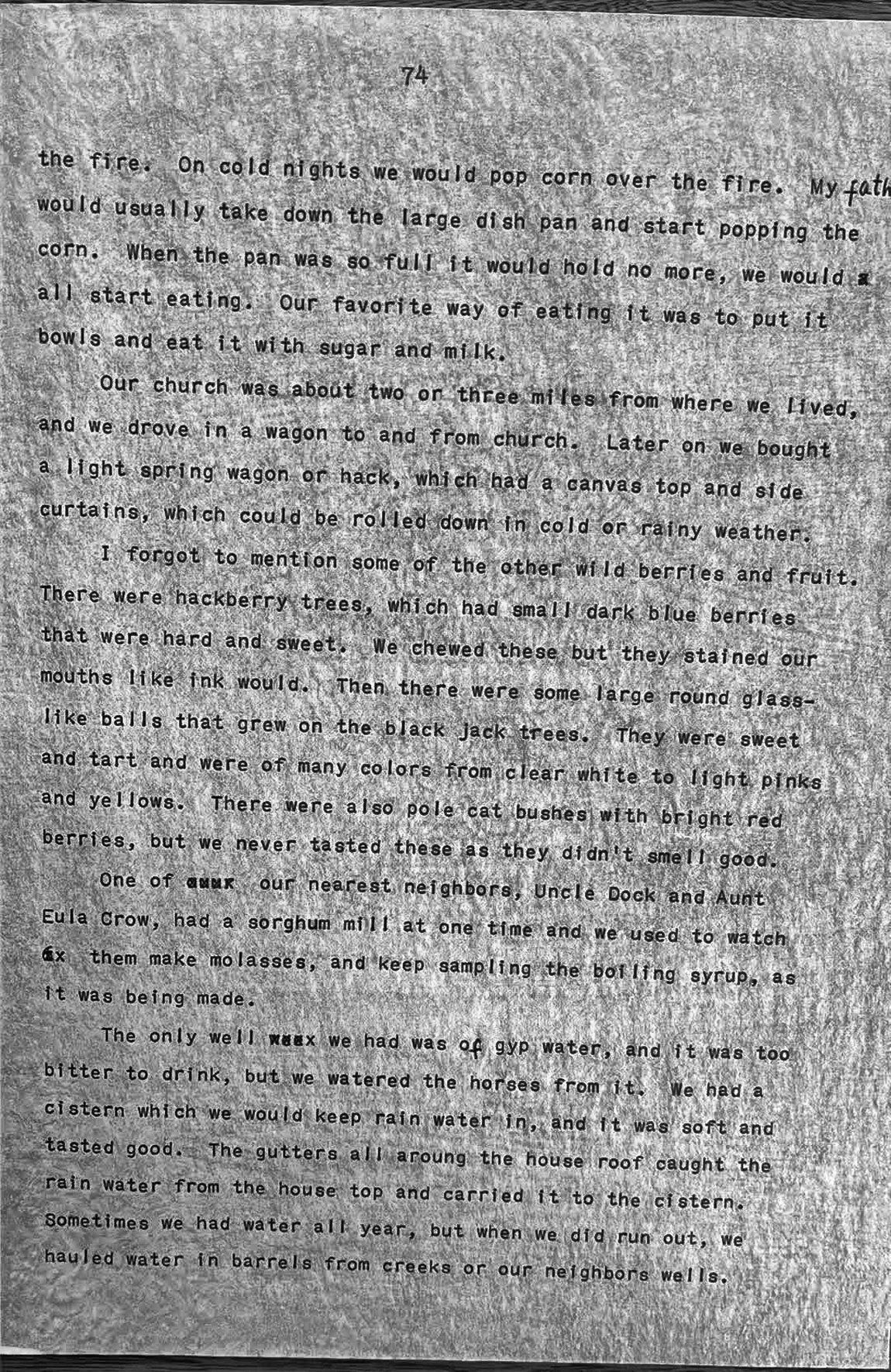
the fire. On cold nights we would pop corn over the fire. My father would usually take down the large dish pan and start popping the corn. When the pan was so full it would hold no more, we would all start eating. Our favorite way of eating it was to put it [in] bowls and eat it with sugar and milk.
Our church was about two or three miles from where we lived, and we drove in a wagon to and from church. Later on we bought a light spring wagon or hack, which had a canvas top and side curtains, which could be rolled down in cold or rainy weather.
I forgot to mention some of the other wild berries and fruit. There were hackberry trees, which had small dark blue berries that were hard and sweet. We chewed these but they stained our mouths like ink would. Then there were some large round glass-like balls that grew on the black jack trees. They were sweet and tart and were of many colors from clear white to light pinks and yellows. There were also pole cat bushes with bright red berries, but we never tasted these as they didn’t smell good.
One of our nearest neighbors, Uncle Dock and Aunt Eula Crow, had a sorghum mill at one time and we used to watch them make molasses, and keep sampling the boiling syrup, as it was being made.
The only well we had was of gyp water, and it was too bitter to drink, but we watered the horses from it. We had a cistern which we would keep rain water in, and it was soft and tasted good. The gutters all around the house roof caught the rain water from the house top and carried it to the cistern. Sometimes we had water all year, but when we did run out, we hauled water in barrels from creeks or our neighbors wells.
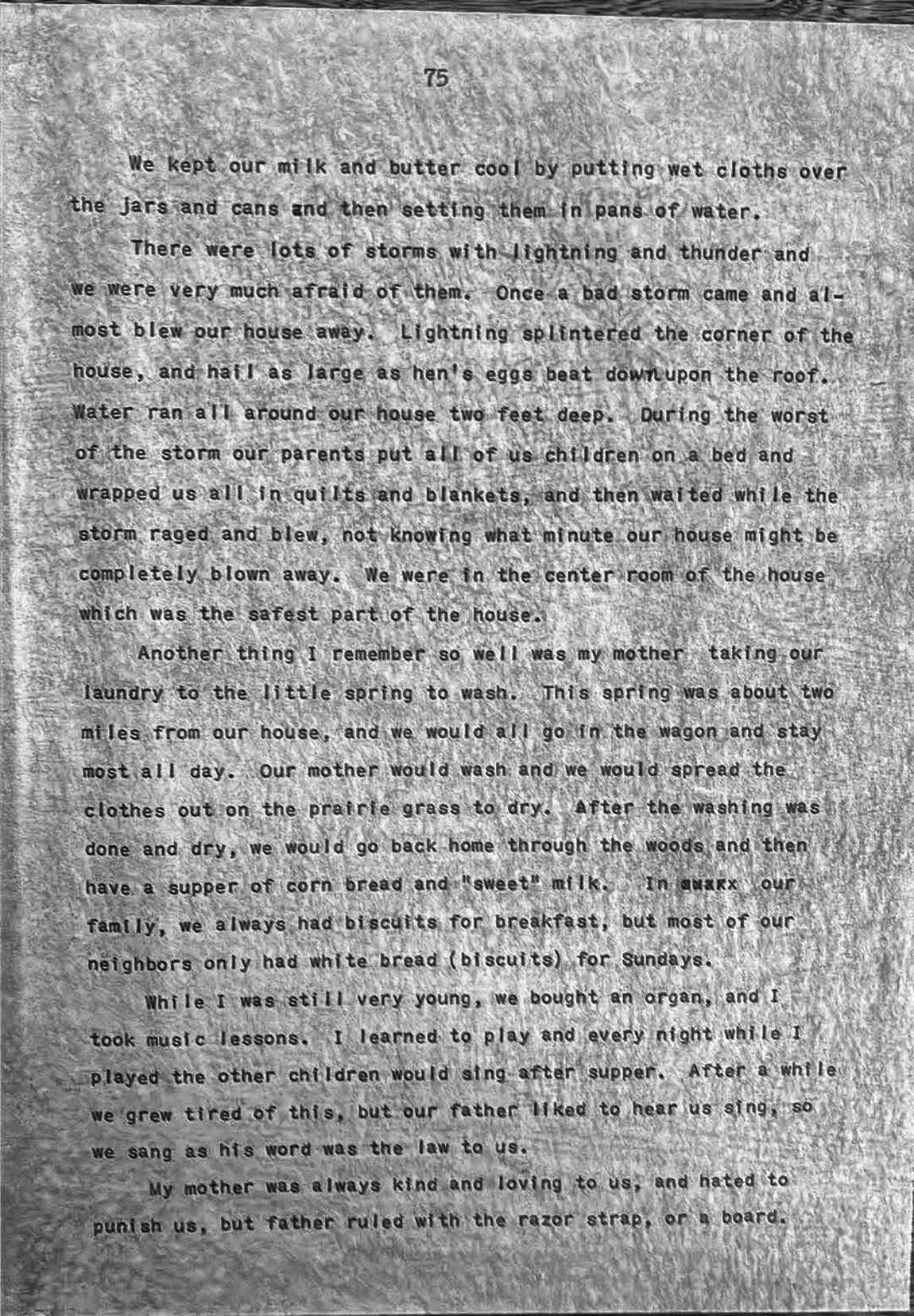
We kept our milk and butter cool by putting wet cloths over the jars and cans and then setting them in pans of water.
There were lots of storms with lightning and thunder and we were very much afraid of them. Once a bad storm came and almost blew our house away. Lightning splintered the corner of the house, and hail as large as hen’s eggs beat down upon the roof. Water ran all around our house two feet deep. During the worst of the storm our parents put all of us children on a bed and wrapped us all in quilts and blankets, and then waited while the storm raged and blew, not knowing what minute our house might be completely blown away. We were in the center room of the house which was the safest part of the house.
Another thing I remember so well was my mother taking our laundry to the little spring to wash. This spring was about two miles from our house, and we would all go in the wagon and stay most all day. Our mother would wash and we would spread the clothes out on the prairie grass to dry. After the washing was done and dry, we would go back home through the woods and then have a supper of corn bread and “sweet” milk. In our family, we always had biscuits for breakfast, but most of our neighbors only had white bread (biscuits) for Sundays.
While I was still very young, we bought an organ, and I took music lessons. I learned to play and every night while I played the other children would sing after supper. After a while we grew tired of this, but our father liked to hear us sing, so we sang as his word was the law to us.
My mother was always kind and loving to us, and hated to punish us, but father ruled with the razor strap, or a board.
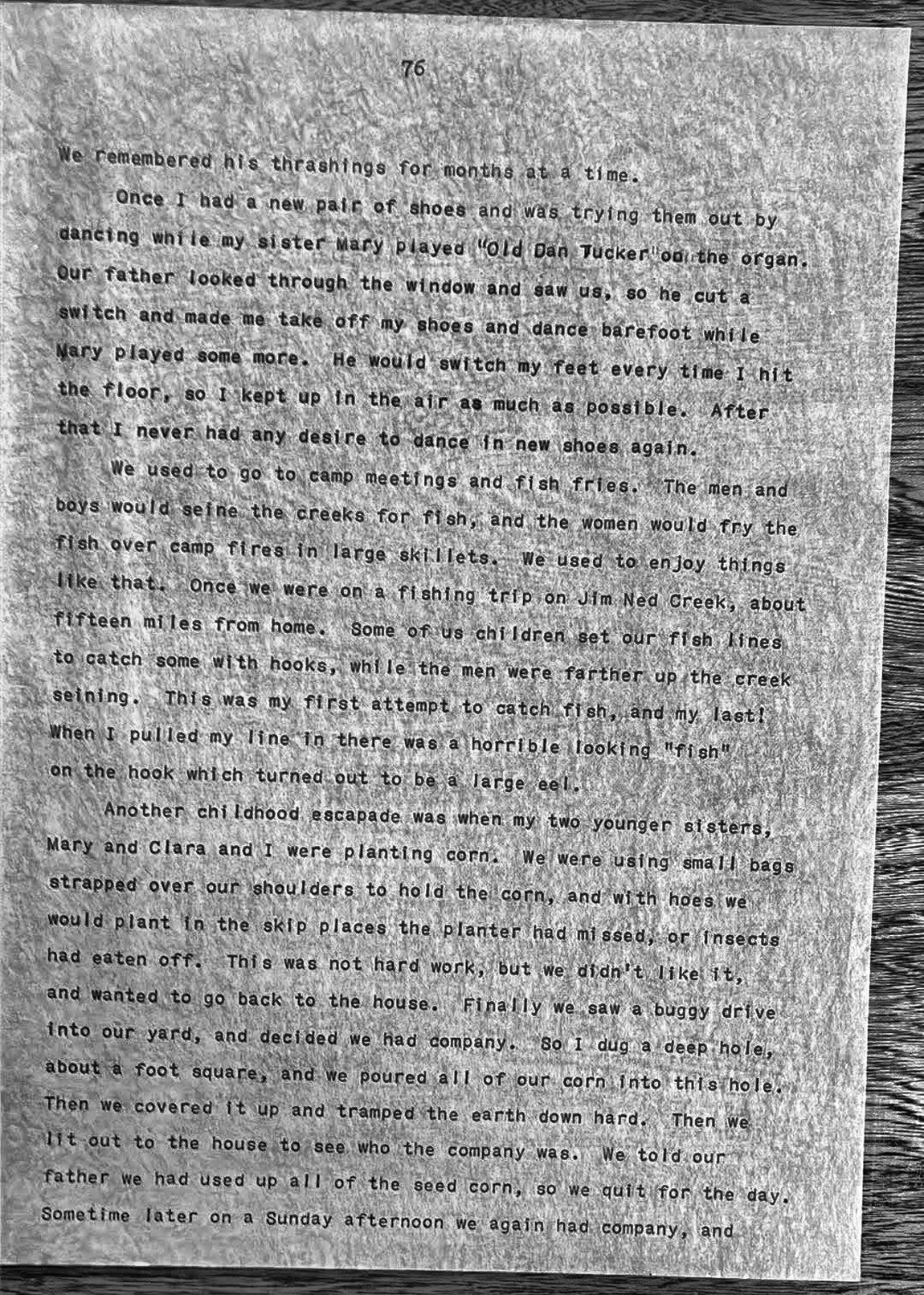
We remembered his thrashings for months at a time.
Once I had a new pair of shoes and was trying them out by dancing while my sister Mary played “Old Dan Tucker” on the organ. Our father looked through the window and saw us, so he cut a switch and made me take off my shoes and dance barefoot while Mary played some more. He would switch my feet every time I hit the floor, so I kept up in the air as much as possible. After that I never had any desire to dance in new shoes again.
We used to go to camp meetings and fish fries. The men and boys would seine the creeks for fish, and the women would fry the fish over camp fires in large skillets. We used to enjoy things like that. Once we were on a fishing trip on Jim Ned Creek, about fifteen miles from home. Some of us children set our fish lines to catch some with hooks, while the men were farther up the creek seining. This was my first attempt to catch fish, and my last! When I pulled my line in there was a horrible looking “fish” on the hook which turned out to be a large eel.
Another childhood escapade was when my two younger sisters, Mary and Clara and I were planting corn. We were using small bags strapped over our shoulders to hold the corn, and with hoes we would plant in the skip places the planter had missed, or insects had eaten off. This was not hard work, but we didn’t like it, and wanted to go back to the house. Finally we saw a buggy drive into our yard, and decided we had company. So I dug a deep hole, about a foot square, and we poured all of our corn into this hole. Then we covered it up and tramped the earth down hard. Then we lit out to the house to see who the company was. We told our father we had used up all of the seed corn, so we quit for the day. Sometime later on a Sunday afternoon we again had company, and
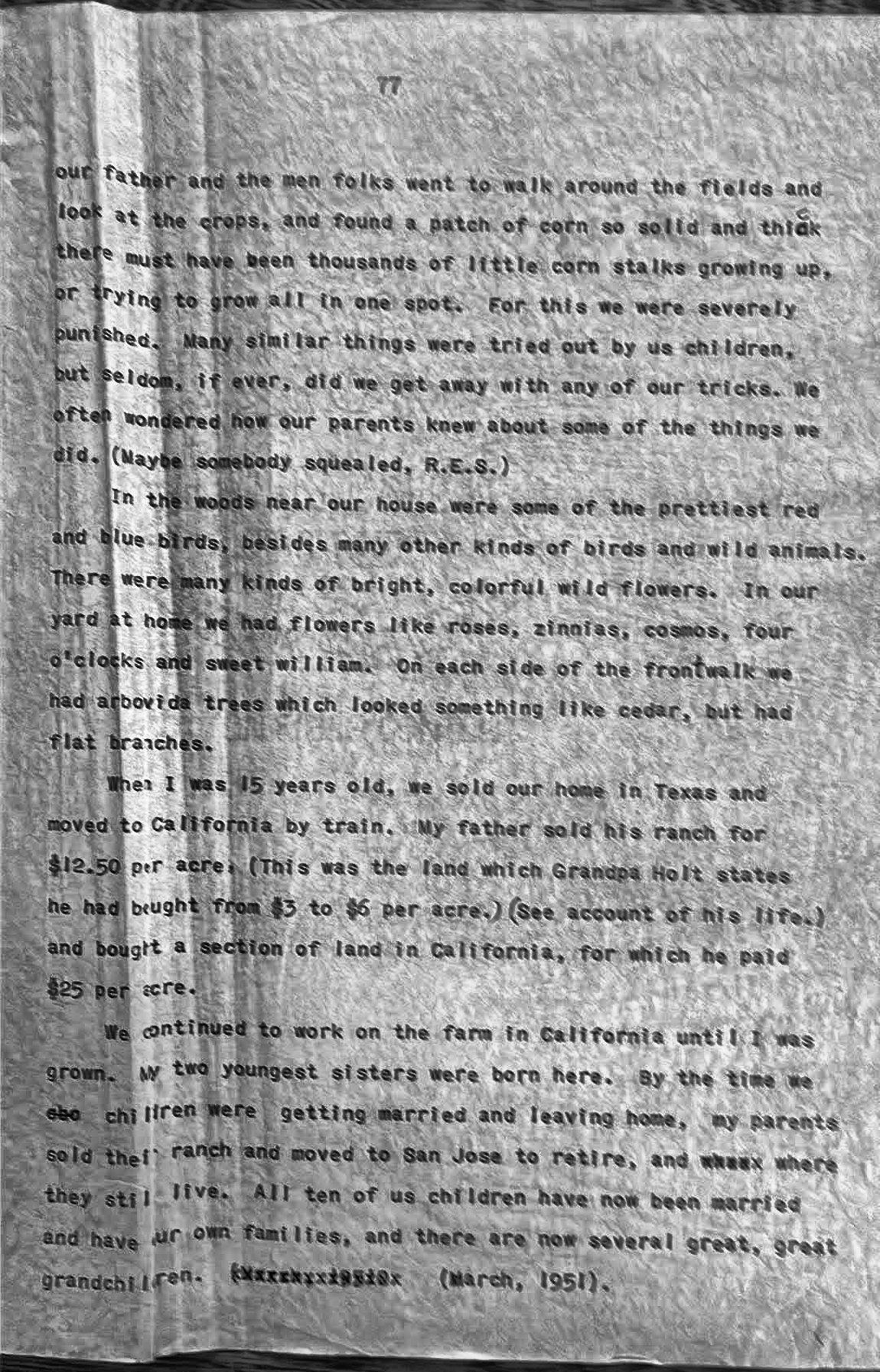
our father and the men folks went to walk around the fields and look at the crops, and found a patch of corn so solid and thick there must have been thousands of little corn stalks growing up, or trying to grow all in one spot. For this we were severely punished. Many similar things were tried out by us children, but seldom, if ever, did we get away with any of our tricks. We often wondered how our parents knew about some of the things we did. (Maybe somebody squealed, R.E.S.)
In the woods near our house were some of the prettiest red and blue birds, besides many other kinds of birds and wild animals. There were many kinds of bright, colorful wild flowers. In our yard at home we had flowers like roses, zinnias, cosmos, four o’clocks and sweet william. On each side of the front walk we had arbovida trees which looked something like cedar, but had flat branches.
When I was 15 years old, we sold our home in Texas and moved to California by train. My father sold his ranch for $12.50 per acre. (This was the land which Grandpa Holt states he had bought from $3 to $6 per acre.) (See account of his life.) and bought a section of land in California, for which he paid $25 per acre.
We continued to work on the farm in California until I was grown. My two youngest sisters were born here. By the time we children were getting married and leaving home, my parents sold their ranch and moved to San Jose to retire, and where they still live. All ten of us children have now been married and have our own families, and there are now several great, great grandchildren. (March, 1951).
Scans courtesy of Laurel Sharmer. Original typed by Ruby Evangeline Wilson Sharmer, January 1962.

