Ruby E. Wilson graduated from the University of California (“Cal”) in 1930 and went to Arizona to teach high school in Tombstone. After a few years there she was so lonely that she gave up the job and came home to Planada.
Her father, James W. Wilson, was Planada’s postmaster, and he passed the job on to Ruby. It was at the post office counter that she met Joe Sharmer: he came in to mail a package, and it was love at first sight.
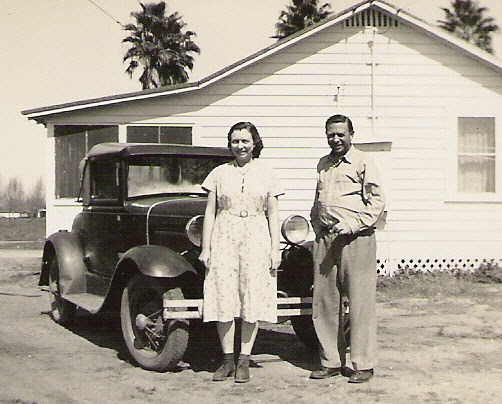
Ruby needed a place of her own, so she ordered a mail-order kit house, the kind sold by Sears and its rivals. The materials came by train, along with a crew of men who put up the whole house in a week. It cost $700, which she paid in two payments of $350. This was the middle of the Great Depression. The house is the one behind Joe and Ruby in the photograph above, which is also on the front page of this site.
In the letters
Knowing that Ruby ran the post office makes several lines in Joe’s letters fall into place. On his first night in Cincinnati he pictured her “just putting up the mail,” three hours behind him in Planada, and he teased her about the “good service” of the “Good old US Mail” (A Dead Ringer for Mama). After Christmas he wrote, “I am very happy for you that the Xmas Rush is over,” the busiest weeks of the year for a postmaster (Still a Baby in Their Eyes). And his Christmas Eve envelope needed no street address at all, just “Planada, Calif.”: it was going to the postmaster herself (You Are My Pal).
From the family
Joseph and Ruby’s daughter:
“She graduated from Cal in 1930 and went to work teaching high school in Tombstone, Arizona. After a few years she was so lonely she quit her job and returned to Planada. Her father was the Planada postmaster, but he passed the job along to your grandmother. It was in the post office your grandparents met. He had come in to mail a package and it was love at first sight.”
“She needed a place to live so she ordered one of those Sears type kit houses. The materials were delivered on the train and was accompanied by a crew of men who built the entire house in a week. She paid $700 for the house and paid for it in two $350 payments. This was in the middle of the Great Depression so that explains a lot. I have the receipt for the house somewhere and I’ll save it for you if I run across it.”

